This entry is part 1 of 24 in the series Tension, suspense and surprise

I’m brushing up today on creating tension in a scene. There are lots of “tricks” and techniques to get the “tension in every page” Donald Maass recommends. While I don’t really go in for resorting to tricks to create suspense, little techniques can really establish, increase or build the tension within a scene.

The list:

  1. Give a character a goal in each scene
  2. Setbacks to a character’s goal in a scene
  3. Uncertainty—often from a lack of information
  4. Worry—plenty of bad information
  5. Doubt, especially in one’s self (the character, not the writer ;) )
  6. Raise the stakes—put more people or a bigger, more valuable objective in danger
  7. bite nails

  8. Increase the odds against the character
  9. Make the characters care more—greater emotional stakes
  10. Make things more challenging
  11. Surprise character or event to change things up
  12. Nonhuman obstacles—setting or weather interfere
  13. Using the POV of a character that doesn’t know something vital (something we’ve established in another POV)
  14. End the scene with a foreboding foreshadowing
  15. Play on a character’s inner anxieties—push them to the limit (and beyond)
  16. Let the characters blow up—what are the consequences?
  17. “Minidisaster”—a preview of what could happen in the big disaster, by showing a small version of their impending doom.
  18. A close call
  19. A character purposefully withholding info from another
  20. Jump cutting to another scene/storyline immediately after a disaster
  21. Make characters’ goals look impossible. Or just make them impossible.
  22. Stating a chilling fact.
  23. Danger—dangerous, skillful work.
  24. Deadlines approaching
  25. Foreshadowing a coming confrontation
  26. grip knuckles

  27. An unfortunate meeting
  28. Trapped in a closed environment (perhaps a crucible?)
  29. Fears coming true
  30. Set up any of these situations and prolong them, rather than relieving the tension
  31. Remove characters’ supports
  32. Disable characters’ strengths
  33. Undermine characters’ belief systems (not necessarily in a religious sense, but in a “I’m fighting for the greater good—holy crap, what do you mean the victim’s a bad guy?” kind of way)
  34. Move up the deadline
  35. Avoid low-tension scenes (sequels, really):
    • Thinking (esp while driving between one scene with live action and another)
    • Decompressing or cleaning up
    • Coffee breaks
    • “Aftermath” scenes
    • Sometimes, even love scenes—a sex scene releases all the sexual tension you’ve established, so then you have to reestablish that tension with something to keep them apart. Though this can be done well, often, this is where we get the contrived or entirely external conflicts that just aren’t that compelling.
  36. Leave out the parts people skip ;) —distill scenes to their essential parts
  37. Cut small talk (unless you’ve worked hard to establish that the small talk is covering something else, something with a lot of tension, or you’ve got a lot of subtexting)
  38. Make one character’s scene goal conflict with another’s scene goal
  39. Make us root for the other guy—make the antagonist a sympathetic character, so we want both sides to win.


Sources: Revision And Self-Editing by James Scott Bell, Stein On Writing by Sol Stein, Writing the Breakout Novel by Donald Maass, and me, of course.

What do you think? What do you do to create or increase tension in a scene? How can you implement these ideas in your work?

Photo credits: nail biter—Cavale Doom; knuckled grip—Alex Schneider

Comments 6 Comments »

This entry is part 2 of 24 in the series Tension, suspense and surprise

The suspense is killing me! I hope it will last.

—Oscar Wilde

Today we’re kicking off our series on tension, suspense and surprise. (I mean . . . surprise!)

It’s easy to look at those elements and think, “Oh, that’s good for a mystery or a romance, but my story doesn’t need those things” or “I’m not writing suspense, why does that matter?” But really, every story should have suspense, tension and surprise. Why are these elements so important? They’re what keep readers reading. Sadly, readers aren’t as indulgent as your friends and critique partners—we have to give them a reason to believe read on.

tss series medSo what’s the difference between the three? Surprise is fairly obvious, but suspense and tension are often used interchangeably (and I’m sure at least some of my sources won’t use the same terminology that I’m choosing). However, for the purposes of this series, I’m going to use “suspense” to mean things that propel us forward in the story—things that make us want to read the next scene. “Tension” will be the events within a scene that keep us from skipping that scene to get to see the next one ;) .

In other words, tension is a scene-level (or page-level, since we will be looking at Donald Maass’s book) element—something that makes this particular scene interesting, that makes us care about it as readers. Suspense is the larger, overarching thing that keeps us reading once the scene is over—though, like I said, there’s plenty of overlap in those areas anyway.

Surprise, like I said, is fairly obvious. An unexpected event occurs. (This would be a counterexample.)

All three are necessary for a good story. I like the way Noah Lukeman puts it in The Plot Thickens: 8 Ways to Bring Fiction to Life: “Suspense, more than any other element, affects the immediate, short term experience of the work” (119). Tension can be used to create that suspense, compel readers to read through the scenes themselves and keep them interested. Surprise is important because, well, nobody wants to read a story where they already know everything that’s going to happen!

So for . . . the next little while, we’re going to look at how (and how not to) create tension and suspense, how to use them, and how and when to use surprise.

What do you think? How would you differentiate between suspense and tension? What areas or topics interest you most for these elements?

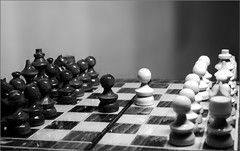
Photo credit: Aart von Bezooyen

Comments 5 Comments »

This entry is part 3 of 24 in the series Tension, suspense and surprise

Although I came across this advice over and over again, I hadn’t planned to include it. I thought it was already covered in the 37 ways to build tension and suspense, and I didn’t want to just list those again. But just mentioning “raise the stakes” probably isn’t quite enough for how important this technique is.

Quite simply, if the stakes aren’t high enough in your book, other fixes may not be able to compensate. If Grandmama’s prized teacup poodle is the only one who’s going to suffer if the bad guys win, other attempts at suspense and tension may seem forced. (Is Butch really going to pull a gun over Gigi?)

Donald Maass (Writing the Breakout Novel, 59-80) and Noah Lukeman (The Plot Thickens, 121-123) both specifically point to raising the stakes. In the suspense structure we looked at earlier, establishing the stakes was a crucial goal of Act I, as was raising them in Act II.

So, how do we do that? Maass gives a few ways: establish a high value on human life (especially if this hero[ine] is going to have to kill), and create public and private stakes—ways in which the public at large and the characters on a personal level will suffer if they lose. In Revision And Self-Editing, James Scott Bell also gives specific ways to raise those stakes:

  • Plot stakes: brainstorm new ways things might go wrong for your Lead—and push yourself. Go crazy; there are no bad ideas. Come up with at least 6 ideas.
  • Character stakes [Maass's personal stakes]: put the character into a dilemma. Stick him between a rock and a hard place and make him choose. List all the reasons why he must take option B and why he shouldn’t take option A—even though he needs to (and will) take option A. And/or make it personal—threaten or hurt the Lead, or better yet, someone they care about.
  • Societal stakes [Maass's public stakes]: How might society be hurt if things go wrong? How can you show that, on a small scale or through extrapolation? (231-233).


Finally, Noah Lukeman points out that even seemingly small events can have big personal stakes—he uses the example of getting the trash to the garbage truck in time. Not a major stressor for most of us, but if you’ve forgotten for the last three weeks, and your landlady’s going to evict you if you don’t get that garbage out of your place, suddenly it matters.

So give Gigi a rest.

What do you think? How else can you raise the stakes?

Photo credits: black poodle—Rachel K; white poodle—buhreee

Comments 4 Comments »

This entry is part 4 of 24 in the series Tension, suspense and surprise

We haven’t touched on surprise too much, despite it being in the title of our series. There are two reasons I included it: the difference (or delicate balance) between suspense and surprise, and the fact that surprises can be used to create tension and suspense. But surprises can also be done very, very badly.

Most of the time, surprises shouldn’t come out of left field from the other side of the Green Monster. As writers, it can be very gratifying to pull one over on your readers. But it’s even more gratifying if you’ve surprised them despite the foreshadowing and clues you’ve planted throughout your story. Without something the reader can go back through and identify as a clue (“Oh, man, I should have seen it coming!”), they’re likely to feel betrayed.

The clues and foreshadowing can be a great tool to build an amorphous suspense. If you keep them vague but strong, that sense of foreboding will carry through your work, pulling the readers with it—and they’ll still be stunned when you pull off the big reveal.

But I think the worst kind of surprise is when we base a surprise on something the point of view character already knows but hasn’t told the reader. To me, that’s basically lying—leading the reader to believe that we’ll all be together and we’ll tell the reader everything, but holding back the one thing that our character would know or think or realize that would make the experience complete for the reader.

I don’t mean that we have to spell out everything the character knows the exact second he or she knows it—or have the characters spill their guts to one another. But if the main character has known the truth all along—or they came into the story knowing some arcane fact that’s going to solve the case—that’s the kind of surprise that’s going to ring false to a reader unless it’s supposed to be the point of the whole story (and even then . . . ouch).

So how much foreshadowing is enough? It depends on how big the surprise is—and how central it is to the plot. (Helpful, I know.)

What do you think? How have surprises you’ve read (or written) fallen flat?

Photo by Benson Kua

Comments 3 Comments »

This entry is part 5 of 24 in the series Tension, suspense and surprise

This may be a little obvious, but the most basic source of tension, suspense and surprise is conflict. We all know it makes a good story, but it can also make a story great.

All techniques to create suspense and tension have conflict at their heart. Just check out my 37 ways to increase suspense and tension—most of them involve creating or highlighting conflict.

Obviously, most of the external plot and internal conflict come from conflict—the obstacles that stand between our protagonist(s) and their goal. That will be the main source of the suspense that keeps the readers wanting to know more.
However, on a smaller level, conflict within a scene establishes and heightens the tension. This is one reason why it’s so important to have a scene goal for the character—once the character wants something, it’s easy to bring in that conflict, to prevent them from getting that goal. A story where the character decides he wants chips, goes in the kitchen and gets chips . . . well, it really isn’t a story, is it?

Rather than being an element to create surprise, conflict is important in making a surprise matter. An unexpected event has a much bigger impact if that surprise creates conflict. Take Jane Eyre. (If you’ve never read it, SPOILER ALERT.) Jane and her employer, Mr. Rochester, fall in love. Imagine if the surprise revealed at their wedding is that the source of the spooky noises in the mansion was his crazy sister? “Oh, well, you have a questionable genes. I still do.” The end. But his crazy wife? That’s a real surprise—and a real conflict.

Conflict, on a macro level and a micro level, is not just the heart of a story—it’s the heart of suspense and tension, as well. It’s what makes the events—and especially surprises—of a story matter to us.

What do you think? How else can conflict create suspense, tension or surprise?

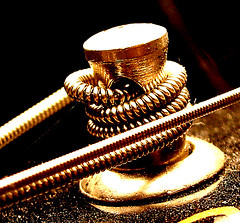
Photo credit: Cristian V.

Comments 3 Comments »

©2008-2012 Jordan McCollum, except indicated images. All rights reserved.