narrow slide 4
narrow slide 3
narrow slide 1

Tag Archives: clues

The Heisenberg Uncertainty Principle of Surprise

A portion of this post was originally part of the Tension, Suspense and Surprise series.

In science, the Heisenberg Uncertainty Principle states, basically, that if you know an object’s momentum, you cannot know its precise location at the exact same time. And to apply this principle in writing . . . okay, I’m pretty much just stealing the name because of the word “Uncertainty.”

Uncertainty doesn’t sound like something we want in our fiction, unless we’re going for experimental or highly literary works. But I think that uncertainty—and its cousin, surprise—are a vital part of a work in any genre.

Uncertainty is what keeps people reading. We have to know if the hero and heroine will get together, or if they’ll defeat the bad guys, etc. The principle actually comes straight from real life (and neuroscience):

Livia Blackburne posted a fascinating study on uncertainty in romance: when college-aged women were shown profiles of men who’d seen and rated the women’s profiles, the women were most attracted to the men when they were not told whether the men had rated them average or highly.

The uncertainty made all the difference—the women who were told the men (imaginary, by the way) rated them highly were interested, but not as much as the uncertain women. The uncertain women also reported thinking about the men more often.

For a writer, uncertainty is a powerful tool, and not just in romance. The uncertainty in any story question is a major factor in keeping people reading, and the question of a developing relationship is the biggest draw in a romance (which, it should be noted, is heavily read by women, of course).

I think part of the reason why that uncertainty is so appealing is that the outcome is something we might not expect. While it’s definitely possible to build the uncertainty around something we’re pretty sure will happen (romance and mysteries generally only have one option for a successful ending, and there’s uncertainty throughout), it’s important to remember that a jolt of something unpredictable is vital for a fresh read.

Or, as Arthur Plotnik says in Spunk & Bite: A Writer’s Guide to Bold, Contemporary Style:

Scientists have identified a patch of the forebrain called the nucleus accumbens as a center of pleasure in humans. Imaging shows heightened activity in this area of the brain when people receive a reward—whether sugar treats, money, or drugs. . . .

Unpredictable stimuli excite the nucleus accumbens, while expected stimuli elicit no response. In the experiment that led to this conclusion, researchers Gregory Bruns (Emory University) and E. Read Montague (Baylor College of Medicine) administered squirts of Kool-Aid and plain water to human test subjects in either predictable (alternating) or random patterns. Pleasure-wise, random squirts won it all.

A fresh locution may not be quite the same as Kool-Aid, but writers can extrapolate from the experiment’s conclusion: Brains love that little squirt of surprise. (12)

Uncertainty, and the tension and suspense that come from it, and unexpectedness are both really important in a novel. When you’ve got a huge event coming in your novel you have two choices. You can lead up to it with a lot of anticipation, promises, foreshadowing and/or dramatic irony—building suspense, making it uncertain whether it will happen, generally getting readers anxious. Or you can throw your readers for a loop and just drop it on them (though at least a little foreshadowing is usually good here—hence the spectrum).

Alfred Hitchcock has famously explained the difference (emphasis added):
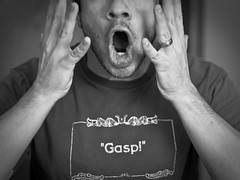
There is a distinct difference between ‘suspense’ and ‘surprise’, and yet many pictures continually confuse the two. I’ll explain what I mean.

We are now having a very innocent little chat. Let us suppose that there is a bomb underneath this table between us. Nothing happens, and then all of a sudden, ‘Boom!’ There is an explosion. The public is surprised, but prior to this surprise, it has seen an absolutely ordinary scene, of no special consequence. Now, let us take a suspense situation. The bomb is underneath the table, and the public knows it, probably because they have seen the anarchist place it there. The public is aware that the bomb is going to explode at one o’clock and there is a clock in the décor. The public can see that it is a quarter to one. In these conditions this same innocuous conversation becomes fascinating because the public is participating in the scene.

The audience is longing to warn the characters on the screen: ‘You shouldn’t be talking about such trivial matters. There’s a bomb underneath you and it’s about to explode!’

In the first case we have given the public fifteen seconds of surprise at the moment of the explosion. In the second case we have provided them with fifteen minutes of suspense. The conclusion is that whenever possible the public must be informed. Except when the surprise is a twist, that is, when the unexpected ending is, in itself, the highlight of the story.

Hitchcock by François Truffaut, p 79-80, as quoted by senses of cinema

Not to disagree with my good friend Alfred, but both surprise and suspense are important. For major events and big promises, suspense is generally better. But for smaller events—especially things that don’t need the extra explaining and won’t live up to the level of suspense—surprise is a great thing.

If we lead up to all the events in a story, we run the risk of being too predictable. If we lead up to none of them, our readers are more likely to experience PTSD than suspense. One is probably better for your event and your story.

How do you determine whether your event should be a surprise or be used to create suspense? Hitchcock’s guideline is a starting place: if it’s a twist ending, surprise is pretty dang important. On the other hand, if that surprise would heighten the suspense throughout the book (without dragging it out too much) and if you can set it up for the audience to know without informing the characters, you could think about whether you could use the extra layer of suspense.

Conversely, consider whether you spend too long building up to minor events—what if you cut all the foreshadowing? Would the reader be slighted or delighted when the surprise is sprung?

What do you think? How do you decide whether an event will be used for suspense or surprise?

Photo by Invizible Man
Do you find this post helpful or inspiring?
Heck yes I do! (0)
Posted in Technique | Tagged , , , , | 2 Comments

What keeps you reading? Romance edition part 2

On Monday, we talked about the draw of uncertainty in romance. There needs to be an element of uncertainty or conflict between the hero and heroine of a romance for readers to be truly vested and interested in the outcome. Predictability is anathema to a story question.

But sometimes, there isn’t conflict between our leads. Sometimes, the romance between them blossoms and grows without too many problems. I think the potential problem here is obvious—even the description sounds boring.

When the course of true love actually does run smooth, we still need conflict. External conflict is good—but if the story is, at its heart, a romance (or possibly a romance hybrid, like romantic suspense), that external conflict really should impact the developing relationship in some way.

Rather than continuing to speak in the abstract, let’s get concrete. A story where Lucy meets Gary, they fall in love and live happily ever after doesn’t sound compelling. Monday, our example was of Lucy meeting Gary and neither of them could tell—and perhaps weren’t sure themselves—whether they would get together, or how the other felt about him/her.

Today, our example is more along the lines of Lucy meets Gary, and Gary is a cop investigating a murder. It’s possible to write a story where the external plot basically has nothing to do with Lucy and Gary’s relationship. I wouldn’t advise that if you’re trying to write a story with the romance as a main plot. Instead, search for ways for the external plot to intersect with the romance plot.

To my mind, there are two basic categories of this intersection: where the external plot pits the hero and heroine against one another, and where the external plot simply gets in the way of their relationship.

For an example of the external plot pitting the hero against the heroine, we’ll go back to Lucy and Officer Gary. Lucy and Gary meet, and they hit it off—until Lucy has information about Gary’s homicide case that she just can’t tell him. Kaye Dacus did this subtly—the police officer hero didn’t have to directly confront the heroine he was investigating—in Love Remains. I do it in at least one of my manuscripts—the heroine has information about the criminals the hero is tracking, but she’s trying to protect him from those criminals, so she steers him away from them at every opportunity.

Alternatively, you could have the external plot simply getting in the way of their relationship. Officer Gary’s murder case interrupts Lucy and Gary’s first date. He stands her up when questioning a witness takes too long. He has to prove his commitment to the relationship by finding a balance between his work life and Lucy. (This isn’t a great example, because that’s kind of life when you’re with a cop, and PS catching a murderer is pretty important, but you get the idea.)

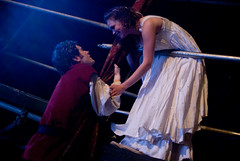
Finally, another way to add a level of conflict to what would be a smooth-course romance—possibly as a subset of the second type of external conflict/love story intersection—is to forbid the romance. This one is a bit harder to do in a contemporary, but many historical settings have rigid rules of fraternization and marriage. However, we can borrow a contemporary example from Shakespeare—their families are enemies, or simply do not understand one another’s cultures. Another contemporary example might be having the hero or heroine already dating someone else, especially someone close to the “real” love interest (best friend, brother, roommate, etc.).

I use this technique in a pretty specialized way in one of my manuscripts: the hero is a priest—or at least the heroine believes he is. (And yes, this is the same MS I mentioned three paragraphs ago. Seriously—read the excerpt and it’ll make more sense.)

What do you think? How do you use external conflict (or like to see it used) to add conflict between the hero and heroine in a romance?

Photo by Paul Morgan

Do you find this post helpful or inspiring?
Heck yes I do! (0)
Posted in Technique | Tagged , , , , , | 1 Comment

What keeps you reading? Romance edition

This week: the return of Writing Wednesday!

I like reading. (Gasp! Shock!) However, I’ve become pickier and pickier in my reading. I no longer feel compelled to finish a book just because I started it. I have waaay too many books waiting that might be better to waste time slogging through something I don’t enjoy. And after all, isn’t that why I read? Because I enjoy it?*

So I really appreciate that the reading public’s eye-time is valuable, and I know that I have to do all I can to make any eye-time I get worthwhile. I’m always interested in what it is that keeps people reading, myself included. To me, characterspeople I care about—and mysteries—questions the story has raised that I want to see answered—are key in getting me to read on.

The “mystery” in a romance should be fairly obvious: will they get together or won’t they? I think it can work well to have the intended couple obvious toward the beginning of the story, but sometimes, it seems like the developing romance is a foregone conclusion—even to the characters. A total lack of conflict between the couple throughout the book raises no questions in my mind about the outcome. To put it bluntly: I lose interest.

Don’t get me wrong: I don’t care for a couple that squabbles bitterly throughout a novel only to do a complete 180 in the last ten pages. I don’t hold out much hope for them. But I need to be wondering about the outcome to feel compelled to read to find out what happens.

This weekend, Livia Blackburne posted a fascinating study on uncertainty in romance: when college-aged women were shown profiles of men who’d seen and rated the women’s profiles, the women were most attracted to the men when they were not told whether the men had rated them average or highly.

The uncertainty made all the difference—the women who were told the men (imaginary, by the way) rated them highly were interested, but not as much as the uncertain women. The uncertain women also reported thinking about the men more often.

For a writer, uncertainty is a powerful tool, and not just in romance. The uncertainty in any story question is a major factor in keeping people reading, and the question of a developing relationship is the biggest draw in a romance (which, it should be noted, is heavily read by women, of course).

Sometimes, though, uncertainty isn’t as viable an option. We’ll need another source of suspense in the romance, but we’ll talk about what to do in those situation—next time (Friday, I hope).

What do you think? What keeps you reading a romance?

*Enjoying reading, to me, doesn’t mean that I have to read something less-than-serious. I enjoy “thinky literature” as well as “mindless escapist genre novels” (and there’s no condescension intended!).

Photo by Courtney Carmody

Do you find this post helpful or inspiring?
Heck yes I do! (0)
Posted in Technique | Tagged , , , | 7 Comments

Building a mystery

Writing Wednesday returns this . . . well, Wednesday!

Feel free to enjoy this song (which my littlest sister would call “really old”) while you read. It’s stuck in my head anyway, if you couldn’t guess from the title.

As we’re burying our clues it’s important to remember that mysteries are central to stories in every genre. As Nathan Bransford points out, mysteries are what keep us reading (emphasis mine):

When it comes to crafting a mystery, I think sometimes aspiring authors get distracted by the bodies and murders and the actual plot mechanics of mysteries, and miss what really drives a great mystery.

Mysteries are about people. And more specifically, they’re about people wanting something, whether it’s an object, person, or knowledge (see also: Do You Know What Your Characters Want?). The character wants the woman to fall in love with him or to catch the killer or find the truth about what happened. We keep reading to find out if they’re going to get it.

Here comes the word math:

A character’s desire + Consequences/stakes + Obstacles + Delay = Mystery

Getting too caught up in the clues and how exactly to bury them isn’t something we need to worry about as we’re brainstorming, outlining, or even writing our first draft. (Unless, of course, you have a brilliant idea during any of those processes—then use it!) The fine work of layering in just enough but not too many clues requires practice, patience and critique partners.

But beyond all that, we have to keep in mind that the real key to mystery, and to suspense in any story is to keep our readers guessing about whether the protagonist will get what s/he wants.

This concludes our series on clues in non mysteries!

What do you think? What are the most important elements of a mystery to you?

Do you find this post helpful or inspiring?
Heck yes I do! (0)
Posted in Technique | Tagged , , | Comments Off

Seeding clues

I’ve been wanting to do this series for a while. As proof, when I saw this article on Story as Garden on Flogging the Quill five months ago, I saved it to use in this series.

In it, Ray Rhamey describes the foreshadowing we’ve mentioned here like “seeds.” He gives a few good examples: setting up a wedding ring that will later save the protagonist’s life, or the massive fist of someone who’ll deliver the knockout punch later (and yes, both of those are literal). Seeding these dramatic turns takes them from the territory of “over the top surprise,” making the reader feel cheated, to the realm of flawless, almost magical storytelling—and, he points out, can help make seeming Deus ex machina plot twists feel, pardon the pun, organic.

This applies across all genres, he says: “A mystery writer must, of course, plant clues—interesting how even the language for doing this kind of thing is from gardening—but the rest of us need to pay attention to our seeding as well, for both action and characterization.”

But if you haven’t been leaving your clues all along, all is not lost! Ray points out that with computers, it’s really easy to go back and add little phrases, hints of backstory (or heck, even whole scenes and chapters) to build up to a new element you’ve decided to add. Here’s his example (emphasis mine):

About a third of the way into a novel, the female protagonist needs to be pulled out of a suicidal dive caused by the tragic death of her once-in-a-lifetime love. She encounters a small boy who seems to suffer from autism. She is a healer, and is sympathetic, but his condition and innocence didn’t seem like motive enough to stir her from her depression.

So what would? How about if the child reminded her in a specific, powerful way of the man she had loved and lost? So the author went back to the scene leading to her love’s death and gave him a “little-boy-lost” look that had always melted her heart. Then the narrative showed her seeing that same look in the eyes of the boy. That stimulus started her on the path of helping the child, which ultimately brought her back to emotional life. The phrase “little-boy-lost” was seeded in three places that added up to powerful motivation for her when the right time came. By the way, the seed had to be distinctive enough to be easily recalled when the time came; in this case, little-boy-lost not only fit unobtrusively the first time it was used, i.e., didn’t call attention to itself, it was distinct enough to remember later.

So seed your novel with small things early on that grow to be significant.

Check out the full article!

What do you think? Do you “seed” your clues as you go, or “post seed,” adding them in behind you once you’re further along?

Photo by Fras1977

Do you find this post helpful or inspiring?
Heck yes I do! (0)
Posted in Technique | Tagged , , , , , | Comments Off

It’s okay to foreshadow

Writing Wednesday will return next week!

If one critique partner pegs the killer by page 30 and another says that the surprise reveal was unfulfilling because it wasn’t foreshadowed, which one is right? They both are, of course, because they can only describe their own experience with the book—but that doesn’t really help you, does it?

Naturally, there are detriments to foreshadowing too heavily:

(You only have to watch 15 seconds to get the message; you don’t have to actually learn the bball technique.)

I watched a movie recently where every time a “little fact” was mentioned, I could see the plot twist they thought they were “foreshadowing.” (“I don’t swim,” says one character. I called it—she was going to fall out of the boat and the lead would have to save her. Took about 30 minutes to get there.) Maybe I’ve just seen too many movies and thought about these things too much, but total predictability is definitely not our goal as writers.

Or, to go back to our basketball analogy:

So, what’s the writing equivalent of a no-look pass? I don’t think a reader has to see a surprise coming. But I think that once the surprise is sprung, readers should be able to remember (ideally) or go back and find the clues you’ve been planted along the way.

In The Plot Thickens, Noah Lukeman gives one example of setting up a surprise—specifically, a secret:

For the secret to be used for suspenseful effect, we have to know there is a secret; Norman Bates’s mother is alluded to in shadowy fragments; in Casablanca Ilsa flat out reveals there is something she cannot tell Rick; in the whodunits, we know from the long looks the staff exchange with each other that someone is not saying something. (137)

Conversely, some surprises don’t actually have to be heavily foreshadowed: if you really can’t foreshadow because none of the POV characters have enough information or interactions to come across those clues, for example.

Again, predictability is not a virtue in most storytelling. It’s not a bad thing to surprise your readers. But it is a delicate balance with foreshadowing and betrayal. Make sure your readers have all the pieces your characters do—but beating your readers over the head with the coming surprise is a good way to ruin it.

What do you think? What’s good foreshadowing for a surprise?

A version of this post was first published on 16 Feb 2010 as part of the Tension, Suspense and Surprise series.

Do you find this post helpful or inspiring?
Heck yes I do! (0)
Posted in Technique | Tagged , , , , , | 2 Comments

The virtues(?) of surprise(!)

There is a difference (or delicate balance) between suspense and surprise. As Alfred Hitchcock points out, we can either seed clues and create suspense, drawing our audience’s emotions out, or shoot for surprise, and go for a big but short-lived emotional bang from the audience. Hitchcock says that suspense is better—and he’s right for the most part—but surprises still play an important role in all fiction.

Most of the time, surprises shouldn’t come out of left field from the other side of the Green Monster. As writers, it can be very gratifying to pull one over on your readers. But it’s even more gratifying if you’ve surprised them despite the foreshadowing and clues you’ve planted throughout your story. Without something the reader can go back through and identify as a clue (“Oh, man, I should have seen it coming!”), they’re likely to feel betrayed.

The clues and foreshadowing can be a great tool to build an amorphous suspense. If you keep them vague but strong, that sense of foreboding will carry through your work, pulling the readers with it—and they’ll still be stunned when you pull off the big reveal.

But I think the worst kind of surprise is when we base a surprise on something the point of view character already knows but hasn’t told the reader. To me, that’s basically lying—leading the reader to believe that we’ll all be together and we’ll tell the reader everything, but holding back the one thing that our character would know or think or realize that would make the experience complete for the reader.

I don’t mean that we have to spell out everything the character knows the exact second he or she knows it—or have the characters spill their guts to one another. But if the main character has known the truth all along—or they came into the story knowing some arcane fact that’s going to solve the case—that’s the kind of surprise that’s going to ring false to a reader unless it’s supposed to be the point of the whole story (and even then . . . ouch).

So how much foreshadowing is enough? It depends on how big the surprise is—and how central it is to the plot. (Helpful, I know.)

What do you think? How have surprises you’ve read (or written) fallen flat?

This post, with a different introduction, originally ran 15 February 2010 as part of the series on Tension, suspense and surprise.

Photo by Benson Kua

Do you find this post helpful or inspiring?
Heck yes I do! (0)
Posted in Technique | Tagged , , , , , , | 1 Comment

Burying clues using context and interpretation

This technique is similar to using framing for burying clues, but distinct enough I think it warrants its own entry in the series.

In this method, the clue really is in plain sight. No tricks to cover it up or conceal its importance—only its meaning. Using the viewpoint character’s perspective, we explain away the clue because we’re seeing it out of context. Perhaps the POV character isn’t hunting for clues right now, or maybe we’ve moved from the plot with the mystery into a subplot involving other characters—anything to move the POV character’s frame of mind somewhere else so that the clue doesn’t seem to bear any extra significance.

To cite an example I gave in the comments of an Edittorrent discussion on burying clues (although this is a mystery, the concept applies across genres; emphasis added):

Let’s say that your plot is structured so that the hero is a detective and there’s been a murder at our heroine’s office (her supervisor was killed [with a staple gun, which our heroine doesn't know], and there’s an obvious suspect). In her free time, our heroine has been helping her best friend start her own cafe.

Our heroine is helping to decorate the cafe (in her subplot). Her BFF asks her to hang the grapevine lattice on the ceiling, since she’s afraid of heights. The heroine takes the lattice and the staple gun up the ladder and obliges.

But really, the BFF is avoiding the staple gun because she killed the coworker (insert motive here). But because we’re out of context, given a plausible alternate explanation, and not in an investigative POV (and note the BFF doesn’t mention the weapon of choice), it’s easy to dismiss it (as long as there’s a clear purpose in the scene, too).

Plus, now the BFF can frame our heroine with her prints on the murder weapon.

Jami Gold also gave a great example of a slightly different methodology for doing this in the comments. The POV character interprets the clues into a context that might make sense to them, but it’s not correct. The heroine thinks the hero’s giving her A Look because he doesn’t approve of the friends she’s going out with (or doesn’t care about her); the hero can’t believe she’s ditching him.

What do you think? How do you use context and interpretation to bury clues?

Photo by Scott Vandehey

Do you find this post helpful or inspiring?
Heck yes I do! (0)
Posted in Technique | Tagged , , , , , | Comments Off
  • Come play!

    Jordan McCollum's  book recommendations, reviews, favorite quotes, book clubs, book trivia, book lists  
     
      Authors Incognito

Author photo by Jaren Wilkey
Theme by Jordan McCollum, based on Back My Book Theme by Writer Website Themes, Mandigo Theme by tom and Twenty Ten by WordPress.
All content © Jordan McCollum 2008 - 2012 except where designated otherwise. All rights reserved