Come play!
Tag Archives: college
Dream. Big.
Once upon a time, I went to college. (Hooray!) I studied humanities. (Hooray!) In case you’re not aware, this isn’t exactly a lead-in to a six-figure job.
I looooved college, and studied as many things as I could. This resulted in several trips to the college advisement center to change or add another major or minor. (It wasn’t that many, I guess: I majored briefly in communications studies, in a different college, and then I changed to a linguistics major, then added an American studies major, and a Spanish minor, and an English minor. Four years, why?)
On one of these trips to add one of these humanities programs to my already full Major Academic Plan, the advisor who had to okay my plan was very hesitant. I was in a hurry—I needed to get to class and expected this to be a simple “Okeedokey!” Instead, the advisor eyed me and my academic records (which were pretty dang good, thank you very much).
“And what do you want to do with your degree?” she finally sneered.
It was a little hard not to laugh in her face. I mean, the woman was an academic advisor in the college of humanities. What did any of the students of English or Classics or Italian Studies plan to do with their degrees?? Why should I, in keeping my options wide open (and without prolonging my time to graduation), be denigrated?
Figuring I probably had little to lose in the office of a woman whose name I hadn’t even bothered to read, I told her the truth: “I want to be a writer.”
It was a little bold, considering I’d abandoned my first and only attempt at a novel two years before, and wouldn’t seriously come back to writing again for four and a half years.
The advisor looked at me over the rims of her glasses. Obviously I’d made a mistake: this woman who had never seen me before and would never see me again sized me up, then held out a hot pink pamphlet. “You might want to take this.”
The trifold advertised a career development class. The message was clear: even in this department of subjects you studied for the love of it, being a writer was not a viable career option.
But I got my second major/minor/whatever it was, and never again darkened the door of the advisement center or the recommended class. I ended up getting a job in writing for marketing for several years, but eventually came back to my first love: writing fiction. And while that’s definitely a crap-shoot and by no means is my success assured, I’ve gotten at least a couple votes of confidence.
Booyah, lady.
I thought of this recently while doing research for yet another novel. I had to dig into my character’s alma mater’s website to figure out what she could’ve majored/minored in. When I visited their version of the college of humanities, the College of Language and Letters, I found this at the top of the page:
Keep away from people who try to belittle your ambitions. Small people always do that, but the really great make you feel that you, too, can become great.
—Mark Twain
(A smaller person would probably comment here about the career ambitions of a College of Humanities Academic Advisor, but I’m above that. And also I can’t think of anything particularly clever and concise.)
Who has belittled your ambitions? Feel free to vent here!
Photo credit: soooo not the actual lady described in this post! by Judy Baxter
Yea or nay for an MFA?
Tomorrow we’ll pick up with our series on clues in non-mysteries!
We’ve talked before about getting an MFA. I’d love to get a grad degree, and I’d love to improve my writing. But in the end, I’m not sure an MFA program is the best choice for me, or for many writers.
And I’m not the only one who feels that way. Gabi Pereira of DIY MFA fame holds a real MFA. She’s grateful for the experience, she’s glad she did it, and she’d do it again, but if you ask her flat out whether she recommends an MFA, the answer is no.

As she actually told an interested MFA student:
“Seriously, if your only goal is to get published: go home, sit yourself at your workspace and write the book. If you think getting an MFA will help motivate you or improve your writing, then it sounds like a good fit for you. But if all you want is a ‘get-published’ card, then just go home and write the book.”
Among other points she makes in a whole series (several of which we mentioned when we talked about it last):
- An MFA is most likely not the only way to get where you want to be in writing (unless that’s teaching).
- It’s dang expensive!
- It’s not the best path to publication.
- Putting your life on hold to study writing isn’t realistic—learning to make writing part of our day-to-day lives is
- Non-literary fiction is often discriminated against.
To be sure, there are a lot of positives to an MFA as well:
- Writing is a priority
- Reading is a priority
- You can survive harsh critiques
- How to work within the writing community
That said, I haven’t totally given up hope. I just have to find a program that is local or low-res, well-funded, into genre fiction… that’ll happen, right?
What do you think? Is an MFA for you?
Photo by Joshua Nixon
To MFA or not to MFA? (Is that the question?)
I. Love. Learning. I loved college, too, and since my husband and I only live about 20 minutes from our alma mater, once or twice a year we head down there to torture ourselves reminisce.
We’ve only been out of school for a few years, so most of campus looks basically the same. But every time we go there, every flier, every display at the library, every student reminds us that the same vibrant, interesting, exciting life is continuing there without us (never mind that it was also exhausting, grueling, and mentally strenuous. Nostalgia.). It seems so easy to step back into that life and learn and grow again. Granted, it won’t be quite the same the second time around, but if I had my druthers, I’d go get a grad degree (somewhere, not necessarily my alma mater).

But . . . in what? Most of the areas I’m interested in pretty much lead only to research or academic career paths (both of which can be fiercely competitive in these fields). And then there’s writing. The best I could get locally was an MFA with an hour commute (each way) or an MA with a vaguely creative emphasis—but last week I found out my alma mater added an MFA program last fall.
So now the question is—do I want it? Yes, of course—and no, of course not.
From what I understand (as I was told by professors), nearly all MFA programs create a certain type of writer—a literary one. Though I would like to style myself as a literary writer, right now my passions lie in genre fiction, and rare is the program where genre fiction (from romance and mystery to YA to scifi) is not at least stigmatized, if not denigrated. And leaving aside the fact that literary fiction is difficult to write and harder to sell, by no means does an MFA guarantee publication—or even publishable writing.
At its heart, any program is only as good as your instructors—and if it’s a workshop setting (which much of the critiquing is in most MFA programs), your classmates are your instructors. While I’m sure that only the best applicants are accepted to the program, that doesn’t automatically make their advice to other writers good (especially if you’re writing genre fiction and no one else is). And though it would be great to get that amount of feedback—I’m not sure my ego can handle two to three years of criticism (even if it is intended to make you better). Finally, it certainly sounds like literary agents are only half-joking when they say that they’ll “try to overlook” an MFA listed as a writing credit.
But still . . . I want those three little letters.
What do you think? Does an MFA appeal to you? Why or why not?
Update: I really like what Eric of Pimp My Novel (he works in the sales department of a large publisher) had to say about MFAs:
So, basically, my view is: if you’re doing literary work, you think you might want to teach college, and you don’t already have a decent job, go for the MFA. Otherwise, you might want to think twice. No one needs a license to be an author, and if you’re considering pursuing the degree purely for some perceived recognition or sense of legitimacy as a writer, you might want to find a new line of work.
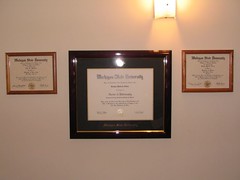
Photos: Harold B. Lee Library—Jeremy Stanley; diplomas—Chris Lawrence


Click for free blog updates via RSS