Posts Tagged “senses”
Posted by Jordan in Technique, tags: auditory learner, blogfest, kinaestetic learner, lds, lds writer blogfest, learning style, senses, sensory writing, tactile learner, visual learner
I was digging through my archives looking for something else when I came across a post that sounded like a really interesting idea. (I can say that because it was a guest post.)
I find that I hit the same senses over and over again, and neglect the others. This happens in writing and in real life, too. I think this has a lot to do with my learning style. During our series on writing the senses last year, somehow I recruited someone with actual expertise to write about how learning styles can affect how we use our senses. Perhaps the most interesting idea is giving our characters different learning styles than we have, and tailoring their sensory experiences to their learning style.
Also beginning with L: this week’s LDS Writer Blogfest. Writers who are members of the Church of Jesus Christ of Latter-day Saints (Mormons) blogged about their favorite address from the latest General Conference. I participated on my other blog. Read all the participants:
Comments Off
by M. Deane
There is one more element to writing with a story with all five senses—style. Years ago, I discovered this hidden element when I took a second job as a dog trainer. My mentor insisted I read books about how humans learn so I could have a better understanding of how to reach our students. What I found out was fascinating—there are three very distinct learning styles.
First, there is the visual learner. Most people are visual learners; these people think in pictures, love lectures where there are diagrams and slides, and usually sit towards the front so they can get an unobstructed view.
Next up is the auditory learner. These are the people who learn through hearing; they like to read aloud or listen to books on tape, and often have to talk through things to grasp a concept.
The last is the kinaesthetic (or tactile) learner. These are the people who learn through touch and movement; they take a hands-on approach to understand what they are learning, and can usually be found fidgeting or doodling during lectures and meetings.
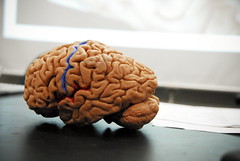
What does this have to do with writing?
Well, there is a two-fold answer to that. Most writers tend to describe things in their own learning style. This can be both a strength—and a weakness. I am a kinaesthetic learner, so I love to throw in action and tactile words. I have no problem describing a couple getting up in the morning, having a conversation while they go through the mundane tasks of brushing their teeth and getting dressed and making the bed. On the other hand, I generally fail to describe visual and auditory cues, such as facial expressions and sounds. I learned this lesson the hard way when I finished a book and then realized I had never once described the color of the truck the main character drove!
The second part of the answer is that writers generally create characters who all share the same learning style. Once I discovered learning styles, I realized that this is another way I can break out of my own viewpoint, and create more depth. Perhaps I am writing a story where I will be exploring the same scene from several points of view. One subtle way to make those viewpoints distinct is to give the characters in the scene distinct learning styles. Perhaps one character walks in, looks around with his hands in his pockets, and immediately notices the unusual burn marks on the wall. The other character, though, puts on gloves and kneels, and begins to examine the remains in the middle of the room.
What is your learning style? Do you think there might be an element missing in your writing because you lean towards your learning style?
Learn more about learning styles
About the author
M. Deane started writing the minute her first grade teacher pressed a pencil in her hands. She currently lives in Central Texas, and works in the IT field. Poetry is her true love, but her muse keeps insisting on making strange forays into fiction. She keeps an online journal, including some writing samples, at http://calamitycrow.dreamwidth.org/.
Photo by djneight
1 Comment »
In my freshman writing class (I think), we read this really amazing autobiography by a man who began a French Resistance group as a teenager in WWII. After a few years, the Gestapo found him and he was sent to a concentration camp for nearly two years. But his story was more than just a story of survival—he was unique not because he survived, but how.
The how is kind of hard to explain, but the basic reason was because saw a type of “light” within his mind that allowed him to discern about people and situations. If he heeded the guidance from that divine light, he was always able to find a way through difficult times.
And the biggest reason he was able to be in tune with this light? He was blind. Being blind also helped him to develop his other senses to compensate, so his hearing was sharper than others’, etc.
Our characters’ senses can be their strengths—but they can also be their crutches (or ours!). Especially when we’re trying to focus on non-dominant senses (i.e. taste, smell and touch), one way to bring these senses out is to deprive our character of other senses in the long term or short term.
You might try this as just a writing exercise, or as a scene to use, but here are just a few reasons a character might lose a sense for a time:
- It’s dark.
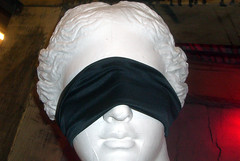
- He’s blindfolded.
- Close-range loud noise (gunshot, anyone?)
- She has a cold. (That can affect smell, taste and hearing. Oh the joys.)
- Medical procedure, such as eye surgery.
-
- She’s wearing hearing protection, ear plugs or even earmuffs.
- Shock.
- He lost his glasses or contacts. (I’d be legally blind without mine.)
You can rewrite an old scene or create a new one where your character doesn’t have access to the full range of senses. If you deprive your character of a dominant sense (sight or hearing), how will her other senses compensate? Does she listen for his tone more carefully or is he especially attuned to the scent of her perfume?
This is an idea I had while writing this series, but it’s not something I’ve had time to try yet. So if you’re up for it, let us know how it goes!
What do you think? How else would senses compensate for a lots one? How might a character temporarily lose one or more senses?
Photo by Mirko Tobias Schaefer
1 Comment »
Last week, I read an excellent article by author Jade Lee (aka Kathy Lyons). It was called “Setting as Character,” but the underlying message is that characters always interpret the setting through their internal lenses (or precepts, the term the author uses in the article).
To help her remember her characters’ internal precepts, Jade assigns them images that reflect (and control) their internal states, external behaviors, clothes, movements—and even what senses they tend to rely on. One of her examples (emphasis added):
The heroine of Cornered Tigress was a skittish cat. That gave me her colors: black and gray. It also gave me how she moves: on her toes silently, or she pounced or stalked. Cats don’t see as well, they’re very texture and taste oriented. So she became a cook and whenever she entered a room, she tasted the air and noticed the fabrics. When she grew frightened, she hid in tiny closed spaces like a closet, but she would fight like a demon when cornered. The hero made her feel safe. When he caressed her, she wanted to stretch and purr.
In the comments, Jade helps others find these images. One thing to remember is not to focus on events, but behaviors and characteristics—internal factors rather than the action of the story (or backstory). Focus on adjectives and describing your characters’ personalities (even if you only have a sketch), then look for something that matches—something in nature, or something man-made, but ideally something that can grow, develop or change. This can even fill in blanks for you as you’re creating a character.
The most instructive comments even give a guide for finding these, and several examples (emphasis mine, again):
Think of your heroine — is she powerful take charge like a race horse? Fiesty, never say die even though it’s stupid like a small terrier? Cold and stand offish like a frozen fountain? seething beneath in anger like a volcano? Get some general words associated with her — three or four key characteristics. You gave me her main baggage issue, but I don’t have a feel if she’s a do-er or a be-er (action first or feel/fit into a situation first before you act) If she’s afraid or angry or determined first. That will lead to more imagery that will lock it down in your head. . . .
[B]ackstory and plot [are] not what makes him unique. And that certainly isn’t what DRIVES him. What are his internal precepts? What gets him out of bed in the morning? What does he believe he has to do in this lifetime before he dies? That will tell me what kind of man he is. And then we can begin fleshing him out with an image.
If you need a different way to look at it—think this…Name one core belief that he lives beyond all others.
Granted, if the best image for your character isn’t an animal, this may not be as helpful in the sensory writing. But it can still help to focus on their senses and the way they interact with their environment.
What do you think? What kind of images spring to mind for your characters?
Photo by Chrissy Wainwright
4 Comments »
Posted by Jordan in Technique, tags: attitude, character attitudes, character passions, character vocabulary, character voice, characterization, Deep POV, lenses, perspective, point of view, pov, senses, sensory writing
Yesterday (and throughout this series), I mentioned that we have to focus on our characters and what they perceive when we detail the sensory information. We’ve talked about how to get into a character’s head (waaay back when), but sometimes seeing with our character’s eyes (or using their other senses) is a bit more challenging than just understanding what they’re thinking.
One thing that I’ve done to work on this (can you tell this is actually what I’m working on now?) is to go through each scene and write down all five senses for that character in that setting. As I do this, I ask myself questions about the character in the setting:
- Which of my character’s emotions or experiences would color this setting? Does the sandy desert remind her of her grandmother’s house, or him of Desert Storm? (Or make up new experiences, if you feel like it.) If you need a setting to have an impact, sensory data could trigger strong memories for your character. Or if you just want your character to have a strong emotional experience, sensory data from the setting might be the way to go. Emotional
- Is this a new setting for the character? If so, keep in mind your character’s personality and purpose there. Someone accustomed to danger might scan for the best escape route first. (And she won’t sit with her back to the door. Don’t even ask.) But if she’s there to meet a friend, looking for that friend will be a close second priority.
- Conversely, is this setting very familiar to the character? If, for example, it’s their home or workplace, they may not “experience” it anymore. So if you need to be in that character’s POV in that setting, focus only on what stands out. Most of us don’t know what our own house smells like (unless we’re the ones buying the air fresheners!), but we’ll notice the overripe garbage.
- In a familiar setting, can I have other people interact with the set? The other characters’ interactions with the POV/owner character’s furniture may suddenly draw her attention to the ratty patch on the arm of the couch where her cat sharpens its claws—or maybe the cat does that itself.
- Do we remain grounded in the setting? Do we go too long without referencing something concrete in the “real world” of the story, devolving into people talking in space? (That’s one of my big things to work on.) Note: we don’t have to redescribe the drywall, but even interacting with a prop keeps us from floating off into space.
- Do we remain grounded in the character? Kind of the opposite phenomenon—do we spend too much time on the description so that we kind of lose track of what the character is doing/thinking/feeling? (And thanks to Andrew for bringing this to mind in the comments!)
What do you think? How do you get into your characters’ senses?
Tomorrow, we’ll have more about picking which senses to focus on for your character!
Photo by Vestman
5 Comments »
|
|