Backstory: the story begins

This entry is part 1 of 20 in the series Backstory

Today is the day: we finally begin our series on backstory!

Backstory is the events that happened before your story starts. Your characters need backstory—but your story may not.

Our characters do need backstory—they need to have come from somewhere, have had experiences that shaped their outlook, attitudes, personalities, and reactions. Backstory rounds out a character, helps us to make their actions consistent and explains their motivations. Thus, backstory can and should be a huge tool for characterization and creating well-rounded characters.

But does your story need backstory included in its pages? The answer is probably yes—but the general rule is that to actually stop the story to play all that out as little and infrequently as possible.

Most of the time, backstory does influence the plot directly: at least part of the important events of a story come before the actual “start” of the story. Take Hamlet, for example: before the play starts, the story events are already in motion—his father is already murdered, and his uncle has already married his mother.

The backstory that creates the opening circumstances may be explained fairly quickly—but some of the backstory may not be revealed until the climax (such as the identity of the murderer) or the resolution (the hero[ine] explains why s/he acts in a certain way—though that may not be the best example. Readers get frustrated with inexplicable actions as much as characters do, so if it’s a POV character, we’d want to explore that a little more).

Coming up: how to tell story from backstory (i.e. knowing when to start your story), avoiding infodumps, using backstory to shape your characters, and a guest post by one of my favorite writing instructors, Margie Lawson!

What do you think? How do you define and use backstory?

Photo by Angela Shupe

We interrupt (well, delay) this series…

I know I promised a series on backstory, but something came up this weekend.

I don’t make a secret of it—I hate writing contests. And this is because I have never gotten useful (or even non-contradictory!) advice from them. That may be a reflection on the organization sponsoring the contests I’ve entered, of course, because after my first contest through another organization, I’m quickly beginning to change my mind.

This last weekend, I went to a writing conference. Despite my past experiences and with more than a little trepidation (and very low expectations), I entered the conference’s first chapter contest a month ago. I was really hoping to place, of course, but I didn’t expect to do well.

Nevertheless, every time I happened to see the Saturday lunch hour in the conference schedule (“First chapter contest winners announced”), my hearing dulled, my heart pounded and my stomach shriveled. Just thinking about that day put me through the first stages of a panic attack.

(This made planning my conference schedule very stressful 😉 .)

Finally, lunch rolled around. About halfway through, the conference coordinator got up, and the pulled up the PowerPoint that would announce the winners on the two 20′ screens in the hall. To all 450 attendees.

They received almost 200 entries. They printed over 900 critiques which would be returned to each entrant after lunch. And then they started on the winners. I almost hoped they’d start with my category, just so I could have my disappointment and work to move on. But no—first came third place, non fiction: title, author. Second place. First place.

They moved on to General Fiction. And another category. And another.

And then my category, Mystery/Suspense. Third place. Not me. Hey, maybe this wasn’t so bad.

Second place. Not me. Oh. There was no way I took first place—so I had my answer. It wasn’t me. That’s okay, I know how much these things are the luck of the draw—get one judge who doesn’t love your chapter and you’re hosed. And not everybody loves everything I’ll ever write. That’s okay.

Seriously, this felt like the longest pause of the ceremonies. Despite my best efforts at consoling myself, I could hear the contest coordinator’s voice saying the title of my story over and over again.

Stop, I told myself. Don’t torment yourself.

“First place, Mystery/Suspense: Saints and Spies.” This time it wasn’t in my head. “By Jordan McCollum.”

So that little announcement is why we’re not starting a new series today. Tomorrow for sure.

This came at a time I really needed it. Many thanks to all those who helped me prepare the chapter. Thanks for a great conference, to all those who worked so hard to put it on. I also want to congratulate so many of my friends who also placed!

Awesome characters—literally

As a follow-up to his March column on Writer Unboxed, which we highlighted last time, Donald Maass takes a closer look at not just situations but characters who inspire awe.

Why is awe so important in writing? Well, to put it simply, it may not be strictly necessary, but it’s an element that will help you craft Maass’s favorite: a breakout novel, one that stays with readers and shakes them to the core. To do that, sometimes, you have to shake your characters to the core, too.

To create characters that inspire awe, he suggests:

Answer the following questions and apply the answers in your current manuscript:

  • What happens in your story that makes your protagonist the most angry? Anticipate that anger three times in the story before the big event.
  • What does your protagonist believe beyond all else? Create a story event that forces him or her to accept the opposite.
  • What does your hero or heroine see about people that no one else does? Find three times when he or she will notice that thing at work.
  • Why does your protagonist’s life matter? At the moment when that’s most true, allow your protagonist to humbly grasp their importance to someone else or to the great scheme of things.
  • As I’m sure you can see that’s just the beginning. Inspiring awe requires building awesome characters.

You might recognize this as very similar to exercises Maass suggests in Writing the Breakout Novel Workbook. These are challenging exercises that prompt you to dig deep into your characters—so have you ever done them? What have you found from exercises like these?

Photo by Paul Fisher

Emotions as action

Have you ever read a book (intended for someone over the age of 12) where the emotions lacked depth? I’m thinking something like “Her puppy died. She felt sad.” While it’s not always bad to tell an emotion like that, if that’s as far as you go in delving into your characters’ emotions, you’re robbing your readers of a rich experience of sympathizing with your characters.

So how can you show emotions? I know I’ve referenced this before, but one of my favorite resources on creating character emotions on the page is the article “Emotion is Physical” by award-winning author and editor Alicia Rasley. (It also goes hand-in-hand with her “Emotion without Sentimentality,” but we’re focusing on the physical now.)

Alicia’s basic premise is that one of the best ways to show deep, overwhelming emotions is through the character’s actions, rather than their thoughts or feelings.

Last month at Writer Unboxed, literary agent extraordinaire (and, by no coincidence, I’m sure, also an author) Donald Maass echoed that idea, with a stronger focus on eliciting that emotion from your readers:

So, now to the practical application: What is the strongest emotion you want your reader to feel? Search and delete that word everywhere it occurs in your manuscript. Now, how will you provoke that emotion through action alone? Got it? Good. Next write down three ways to heighten that action. (Remember that underplaying can also heighten.) When you’ve built a story situation that will force the emotion you want—make it happen.

What do you think? Do you build your story situations or your desired emotional responses first? What do you do to help show your character’s emotions?

Photo by Thomas Levinson

Upcoming series: Backstory

I’m planning my next series (starting next Monday!), and once again, I need your help. I need your questions, musings and and topics.
What do you want to know about backstory? What it is? How to tell it from the “real” story? How to work it in? Whether you need it?

As always, guest bloggers are welcome (check out my guest blogging guidelines here, but of course, the topic will be different this time around—you know, backstory?).

What do you want to know (or write!) about backstory?

Photo credits: question—Svilen Mushkatov

How to dress your story with style

This entry is part 10 of 10 in the series Writing the senses

by M. Deane

There is one more element to writing with a story with all five senses—style. Years ago, I discovered this hidden element when I took a second job as a dog trainer. My mentor insisted I read books about how humans learn so I could have a better understanding of how to reach our students. What I found out was fascinating—there are three very distinct learning styles.

First, there is the visual learner. Most people are visual learners; these people think in pictures, love lectures where there are diagrams and slides, and usually sit towards the front so they can get an unobstructed view.

Next up is the auditory learner. These are the people who learn through hearing; they like to read aloud or listen to books on tape, and often have to talk through things to grasp a concept.

The last is the kinaesthetic (or tactile) learner. These are the people who learn through touch and movement; they take a hands-on approach to understand what they are learning, and can usually be found fidgeting or doodling during lectures and meetings.

What does this have to do with writing?

Well, there is a two-fold answer to that. Most writers tend to describe things in their own learning style. This can be both a strength—and a weakness. I am a kinaesthetic learner, so I love to throw in action and tactile words. I have no problem describing a couple getting up in the morning, having a conversation while they go through the mundane tasks of brushing their teeth and getting dressed and making the bed. On the other hand, I generally fail to describe visual and auditory cues, such as facial expressions and sounds. I learned this lesson the hard way when I finished a book and then realized I had never once described the color of the truck the main character drove!

The second part of the answer is that writers generally create characters who all share the same learning style. Once I discovered learning styles, I realized that this is another way I can break out of my own viewpoint, and create more depth. Perhaps I am writing a story where I will be exploring the same scene from several points of view. One subtle way to make those viewpoints distinct is to give the characters in the scene distinct learning styles. Perhaps one character walks in, looks around with his hands in his pockets, and immediately notices the unusual burn marks on the wall. The other character, though, puts on gloves and kneels, and begins to examine the remains in the middle of the room.

What is your learning style? Do you think there might be an element missing in your writing because you lean towards your learning style?

Learn more about learning styles

About the author
M. Deane started writing the minute her first grade teacher pressed a pencil in her hands. She currently lives in Central Texas, and works in the IT field. Poetry is her true love, but her muse keeps insisting on making strange forays into fiction. She keeps an online journal, including some writing samples, at http://calamitycrow.dreamwidth.org/.

Photo by djneight

Experimenting with your characters’ senses

This entry is part 9 of 10 in the series Writing the senses

In my freshman writing class (I think), we read this really amazing autobiography by a man who began a French Resistance group as a teenager in WWII. After a few years, the Gestapo found him and he was sent to a concentration camp for nearly two years. But his story was more than just a story of survival—he was unique not because he survived, but how.

The how is kind of hard to explain, but the basic reason was because saw a type of “light” within his mind that allowed him to discern about people and situations. If he heeded the guidance from that divine light, he was always able to find a way through difficult times.

And the biggest reason he was able to be in tune with this light? He was blind. Being blind also helped him to develop his other senses to compensate, so his hearing was sharper than others’, etc.

Our characters’ senses can be their strengths—but they can also be their crutches (or ours!). Especially when we’re trying to focus on non-dominant senses (i.e. taste, smell and touch), one way to bring these senses out is to deprive our character of other senses in the long term or short term.

You might try this as just a writing exercise, or as a scene to use, but here are just a few reasons a character might lose a sense for a time:

  • It’s dark.
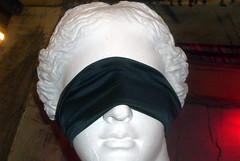
  • He’s blindfolded.
  • Close-range loud noise (gunshot, anyone?)
  • She has a cold. (That can affect smell, taste and hearing. Oh the joys.)
  • Medical procedure, such as eye surgery.
  • She’s wearing hearing protection, ear plugs or even earmuffs.
  • Shock.
  • He lost his glasses or contacts. (I’d be legally blind without mine.)

You can rewrite an old scene or create a new one where your character doesn’t have access to the full range of senses. If you deprive your character of a dominant sense (sight or hearing), how will her other senses compensate? Does she listen for his tone more carefully or is he especially attuned to the scent of her perfume?

This is an idea I had while writing this series, but it’s not something I’ve had time to try yet. So if you’re up for it, let us know how it goes!

What do you think? How else would senses compensate for a lots one? How might a character temporarily lose one or more senses?

Photo by Mirko Tobias Schaefer

Selecting character senses

This entry is part 8 of 10 in the series Writing the senses

Last week, I read an excellent article by author Jade Lee (aka Kathy Lyons). It was called “Setting as Character,” but the underlying message is that characters always interpret the setting through their internal lenses (or precepts, the term the author uses in the article).

To help her remember her characters’ internal precepts, Jade assigns them images that reflect (and control) their internal states, external behaviors, clothes, movements—and even what senses they tend to rely on. One of her examples (emphasis added):

The heroine of Cornered Tigress was a skittish cat. That gave me her colors: black and gray. It also gave me how she moves: on her toes silently, or she pounced or stalked. Cats don’t see as well, they’re very texture and taste oriented. So she became a cook and whenever she entered a room, she tasted the air and noticed the fabrics. When she grew frightened, she hid in tiny closed spaces like a closet, but she would fight like a demon when cornered. The hero made her feel safe. When he caressed her, she wanted to stretch and purr.

In the comments, Jade helps others find these images. One thing to remember is not to focus on events, but behaviors and characteristics—internal factors rather than the action of the story (or backstory). Focus on adjectives and describing your characters’ personalities (even if you only have a sketch), then look for something that matches—something in nature, or something man-made, but ideally something that can grow, develop or change. This can even fill in blanks for you as you’re creating a character.

The most instructive comments even give a guide for finding these, and several examples (emphasis mine, again):

Think of your heroine — is she powerful take charge like a race horse? Fiesty, never say die even though it’s stupid like a small terrier? Cold and stand offish like a frozen fountain? seething beneath in anger like a volcano? Get some general words associated with her — three or four key characteristics. You gave me her main baggage issue, but I don’t have a feel if she’s a do-er or a be-er (action first or feel/fit into a situation first before you act) If she’s afraid or angry or determined first. That will lead to more imagery that will lock it down in your head. . . .

[B]ackstory and plot [are] not what makes him unique. And that certainly isn’t what DRIVES him. What are his internal precepts? What gets him out of bed in the morning? What does he believe he has to do in this lifetime before he dies? That will tell me what kind of man he is. And then we can begin fleshing him out with an image.

If you need a different way to look at it—think this…Name one core belief that he lives beyond all others.

Granted, if the best image for your character isn’t an animal, this may not be as helpful in the sensory writing. But it can still help to focus on their senses and the way they interact with their environment.

What do you think? What kind of images spring to mind for your characters?

Photo by Chrissy Wainwright