Posts Tagged “suspense”
Ready to jump on your writing goals? Sign up for the Pen Olympics at Edittorrent to set a goal for yourself to complete during the real Winter Olympics (ending Feb 28)!
Way back when, I recommended assessing your story’s suspense taking a look at the promises you were making and fulfilling. The example assessment I used (completely made up, of course) showed a list of promises made in various scenes, tracking their progress in subsequent scenes (whether they were fulfilled, delayed or denied). Just so you don’t have to click through again, here you go:
| Scene |
Promise |
Fulfilled |
| 7 |
She’ll meet him at dawn (D)—6 |
A fulfilled |
| 8 |
– |
C fulfilled |
| 9 |
He’ll kill her (E)—10 |
B delayed |
| 10 |
– |
D fulfilled; E denied |
We have a number of simultaneous, conflicting promises building here—a great set up for suspense. But it’s the last scene here that got me thinking. In that scene, apparently, we’re fulfilling her promise of meeting him at dawn, and obviously not fulfilling his promise to kill her. Really, this shouldn’t say that there are no promises made here—we should use the fulfillment of a promise to introduce a new, bigger promise.
Those two promises kept us in suspense, and we’ve now released that anticipation if he just decides, “Oh, I won’t kill her after all. She seems kinda nice.” The suspense level (and probably tension, too) bottoms out.
Instead of just letting it go, we can use this opportunity to add a new promise—since both of those characters have fulfilled or lost their promises, they need a new one to keep us in suspense. It doesn’t always have to come in the same scene, but it had better come pretty quick.
I’m planning to use this myself in my next round of revisions. I spend a while foreshadowing (aka promising and creating anticipation) a meeting between two characters. If they met and were glad/mad/sad to see one another, that lowers the suspense level for their storyline. That release can damage the suspense in my story—or I can channel the previous suspense into a new, related promise. Now character Z has to get character Q to do something, or his whole plan—and maybe their lives—could be in jeopardy.
What do you think? How do you stack promises to create suspense? How have you seen this in other books?
Comments Off
Posted by Jordan in Technique, tags: chapter endings, cliffhangers, katie ganshert, scene, scene charts, scene structure, scene tension, suspense, suspense fix, tension
As I defined the terms at the beginning of this series, tension works within a scene to keep us reading, while suspense is the “suprascenic” feature that keeps us reading after a scene closes. So sometimes, the way to keep people reading is as simple as examining how you end each scene, and especially each chapter.
I’ve made this part of the scene chart—a column where I indicate whether the scene ends on a hook, a segue or a note of closure. The “segue” means that it’s a lead-in to the next scene; the “closure” means that I wrap things up neatly for that character and situation—nothing more to see here, folks. Move along.
To build suspense, avoid the closure ending—especially at chapter breaks, where a reader is most likely to set down your story. As author Katie Ganshert said the other day, End each chapter in a state of unbalance.”
Katie also listed a number of ways to do this:
We could stop in the middle of the action. Find an enticing hook. Foreshadow things to come. . . .
Consider cutting the last paragraph. The last line. The last page. Whatever you need to do to end each chapter on a note of unbalance. A sense that things aren’t well. Make your reader’s stomach squirm and propel them to the next page so they can slay the uncomfortable beast taking root in their bellies.
Related to this is cliffhangers within a scene or chapter. In Fiction First Aid, Ray Obstfeld calls this creating a “suspense pocket” (47). You set up a promise—like someone receiving a letter from someone unknown. Rather than fulfilling the promise immediately and have the character open it right away, try throwing in an event or two that delays that fulfillment. (This can also be characterization or setup, and can make readers pay attention to what would otherwise be a boring scene.)
One caveat: change up the kind of unbalance (and length, for the suspense pocket). Katie’s advice is absolutely excellent—but if we take it to mean that all of our chapter endings come in the middle of a scene, right before a major disaster, it’s going to feel repetitive and forced. Don’t always end in the middle of a scene, or end on a line of foreshadowing worthy of Howard-Shore-John-Williams-dramatic-music-swell (Little did we know, we’d never be the same at the end of every chapter).
Really—I read a book (four, actually, in a series) that did this on every chapter it seemed, and it was so obnoxious. Not just because I couldn’t stop reading in the middle of the chapter, but because it felt like the cheap trick it was. (Every chapter ended on a “hook” all right—one that was resolved in the first paragraph of the next chapter, because it was actually still part of the same scene.) Still liked the books, of course, but I’m still annoyed about that.
What do you think? How else can you end a scene on a note of unbalance?
Photo by spaceodissey
5 Comments »
A heads up: freelance editor Victoria Mixon is offering free edits of novel climaxes (250 words) on her blog until Feb 12!
Sometimes, suspense is low in a story because . . . well, the hero(ine)’s never really in danger. Obviously, not all stories require the hero to risk his life or the heroine to save the whole! world!, but, as Hitchcock said, “The stronger the evil, the stronger the film” (Traffaut 316). Or, you know, book.
This can be especially apparent in the middle of the book. James Scott Bell says “If your readers aren’t worried about your Lead because the opponent or opposing circumstances are soft, the middle will seem like a long slog indeed” (229).
Naturally, we have to start with a strong antagonist, well-matched to our Lead. That doesn’t mean, of course, that the readers have to know who he is—most mysteries revolve around that revelation (whereas most suspense novels revolve around already knowing who he is—greater information, greater suspense. Thanks again, Hitchcock.). We just have to know he’s bad, he’s dangerous, and he’s after our Lead.
We’ve already talked about The Complication of Act II from Fiction First Aid by Raymond Obstfeld, because strong plotting methods include specific events to help us show our antagonists’ strength.
In Larry Brooks’s Story Structure, for example, Act II contains two “pinch points” that are designed to raise the stakes by showing us just how bad the villain is. Even the Mid-Point is designed to help with this, showing the hero more to the story, changing the way he views the world.
James Scott Bell’s Revision And Self-Editing gives more advice on better arming the antagonist, drawing on the “three aspects of death“:
- Does the opposition have the power to kill your Lead, like a mafia don, for instance?
- Does the opposition have the power to crush your Lead’s professional pursuits, like a crooked judge in a criminal trial?
- Does the opposition have the power to crush your Lead’s spirit? Think of the awful mother played by Gladys Cooper in the 1942 film Now, Voyager. She has that power over her daughter, played by Bette Davis. (229)
I especially like Bell’s advice because it applies to more than just life-and-death suspense. Make sure as you arm your opposition that they don’t become “a caricature,” Bell warns—show their shades of gray. And if you end up making your opposition stronger than your Lead, strengthen your Lead to match the villain next.
What do you think? How else can we arm the antagonist?
Photo by Jim Barker
1 Comment »
Fixing the suspense of a story can be a lot tougher than upping the tension in a single scene. Looking at suspense requires us to look at the big picture—and increasing the tension in several scenes can increase the suspense, too.
If you’ve gone back and fixed (or planned how to fix) the tension in several scenes, it might be time to reevaluate your suspense. Rerate your new scenes on tension and redo the EKG. If you’re really lucky, you may not have to do anything.
But then again, you might. Just as tension springs from conflict, suspense is created by anticipation. So the same things that fix scene tension might not fix story suspense.
Suspense is also harder to give general fixes for because it can be a lot more story-specific than tension problems (but I will offer a few ). Only you can tell what’s right for your story (and even then, we usually need help). I can’t just give the blanket “when in doubt, kill someone important,” axiom because that might work for many stories, but if that’s not going to be a focus of your story, it’s more likely to distract and derail than help.
Take a good, hard look at the places you don’t have anything major moving the story along. (Those unhightlighted sections of the scene chart.) You’ll probably have to rethink some of those scenes. (I’m rethinking an entire quarter of my book.) Be open to new ideas—especially when you’re doing other things. Be open to letting go of the things you worked so hard on.
That doesn’t always mean you’ll have to lose your favorite parts—but you may have to find very different ways to get them in there.
What do you think? What are your favorite ways to keep your readers in suspense?
Photo credit: Alex Schneider
3 Comments »
This is very related to yesterday’s point on getting information in there while keeping the tension. Sometimes the dialogue that’s used to convey that information is losing readers and we can’t find any secret agent monkeys or secret bad guys to help out. (And sometimes the dialogue is just dull. Fix that first, and then see if the scene needs more tension.) Now what?
I’ll turn the time over to two of the books I’ve been reading for this series: Don’t Murder Your Mystery by Chris Roerden and Revision And Self-Editing by James Scott Bell.

Bell can start us off with a point we’ve touched on: “Your Lead should be dealing with change, threat, or challenge from the get-go. At the very least, whenever she is in dialogue with another character, that inner tension is present” (97). Bringing out the inner conflicts can add subtext to even the dullest small talk. (But please, make sure that the small talk isn’t so small that it can’t support subtext .)
Roerden adds several techniques specifically for increasing tension in dialogue, since mysteries may require a lot of talky investigation. (And really, how many people would poison a PI’s potato chips?) She mentions bypass dialogue, borrowed conflict, simulated disagreement and flat-out editing (179-184).
Bypass dialogue is when two characters speak but don’t communicate. Naturally, this can be boring, but it can also be used to increase tension: make sure that the speakers have opposing agendas and different priorities, even if they’re friends. (“Transforming allies into temporary adversaries not only increases tension but also builds the reader’s empathy with your protagonist . . .” [180]).
You can also borrow conflict from a background source (a bit like yesterday’s fix). Roerden uses an example from a novel, a reporter interviewing a couple with a tennis game on TV in the background. When she asks about the victim, the husband suddenly swears. The reporter thinks she’s onto something—but he’s just upset about the game.
Simulated disagreement is a bit more tricky—obviously, the name refers to when two characters seem to disagree without actually doing so. In the example Roerden cites, two female characters are trying to relate a creepy occurrence (which we’ve already seen dramatized) to a male third character. He has no real reason to disbelieve or oppose them, but he repeatedly interrupts them (increasing the tension) with stories of his own. One of the women (his wife), gets on his case for interrupting, further heightening the tension.
Finally, flat-out editing can help—especially for phone calls. (Eesh. I hate those!) Roerden uses the example of a phone call from a novel where the protagonist is in her car, realizing she needs to get a clue from her husband. She’s already thought about the context—when they heard it, what bit of information it is exactly—so why show that in a phone conversation? Indeed, after the words “she called him,” the author skips right to the husband’s answer: “‘Yeah, I’ve got it right here. . . ‘”
CLOSING CAUTION: Overusing any technique or tension fix can be gimmicky or hackneyed—and can actually undercut the tension. Mix up your tension techniques to keep your readers reading without getting bored.
What do you think? Any good examples of the above fixes? Any other tension fixes? (Next week, we’ll look at suspense fixes, so let me know if there’s another tension fix you’ve used successfully—and if you’d like to guest post about it, just let me know!)
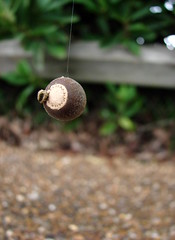
Photo credits: fraying rope—Govind Chakravarti; acorn hanging by a thread—Karen Dorsett
Comments Off
|
|