Posts Tagged “voice”

Confession time!

I totally use a thesaurus. Even while drafting. If I’m repeating a word too much and I just know there’s an easy synonym (it’s that tip-of-the-tongue syndrome!), words that are so quick and easy that they’re in the standard word processor thesaurus, I look them up. And if you’ve got a good thesaurus, it’s fun to gambol in the Word Nerd-ery sometimes.

But I’ve also seen thesaurus use gone bad, and I’ve learned the hard way that the thesaurus isn’t always your friend. (Seriously, scarred for life. I was like 11 and it’s so embarrassing, I still can’t share it.)

Thesauruses: the good, the bad and the ugly

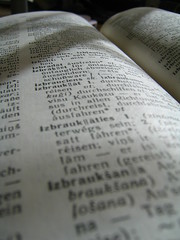
With my affection for thesauruses, I was excited to read Arthur Plotnik’s Spunk & Bite [affiliate link] chapter reveling in thesauruses. He gives some excellent tips on using thesauruses wisely:

  • Understand Roget’s’ possibilities. Use a thesaurus to

    • discover more fitting or more forceful words;
    • find those good words you can’t quite recall [hello!];
    • avoid repetition of words [oh yeah];
    • escape clichés and worn modifiers;
    • help describe the so-called indescribable;
    • refine your intended meanings (via related concepts); and
    • simply luxuriate in the plenitude of language.
  • But understand Roget’s‘ limits
  • Before embracing an unfamiliar word, look up its definition and usage in a good dictionary.
  • Don’t fish in the categories, swim in them.
  • Don’t grab all the words that fit.
  • Search your brain as well. [He recommends flipping to a section that has nothing to do with the subject at hand, like describing light using words from the "Violence" section: savage, brutal, etc.]
  • Use new and/or older editions.
  • Take chances.

(77-78)

What’s my favorite thesaurus? I happened to find an Oxford American Writer’s Thesaurus [affiliate link] at a local thrift store (I agonized over the $3, but it’s so worth it!). It’s got fun little asides by famous authors for some of the words, fantastic breadth—I love this thing.

Of course, we all know the difference between the right word and the wrong word is the difference between lightning and a lightning bug—and thesauruses alone can’t tell us if a word is truly the right one. But relying on Plotnik’s tips is one good way to make sure we get a good start from thesauruses.

The Naming of Things
Plotnik also recommends another way to find the perfect word: finding the right name for things. Visual dictionaries and word lists are the best tools for these things, with terminology for very specific things arranged by subject. If you need to set a scene or use industry-specific terms, check out one of these resources that Plotnik recommends:

The “Right” Word
But as with thesauruses, just knowing the “right” word doesn’t necessary make it the right word (tautology FTW!). When we look up an obscure term for our research in our setting, it might be right in the sense that it describes it accurately—but even if it’s right in that sense, if your audience doesn’t know the term, it won’t help them visualize it. Then is it “right”?

In a day of instant information, readers really do put down books to look stuff up. I even documented a time I did that here on the blog: a novel I was reading named an obscure medical device, as if that would be enough for us to picture it being used as a weapon. It was not, I opined, the right word because I couldn’t visualize the pivotal weapon throughout the scene and, frustrated, put the book down to hop on the Internet. (And being me, it was some time before I got back to it, most likely.)

As a writer, I went through this with the word “inveigle” in one manuscript (okay, since we’re confessing: I’ve been through it a lot in pretty much every manuscript, but this is one of my stories). I found it in a thesaurus and the definition looked right.

I decided to ignore the fact that pretty much everyone I had read it—intelligent, college-educated people who really like me—tripped over that word and pointed it out. It was Capital-R-Right and nobody was going to convince me otherwise. After all, isn’t reading how we grow our vocabularies? Didn’t I see, like, one blog comment once where someone said they liked a book to teach them some new words??

If the logic sounds tenuous, it was. Finally, after yet another friend mentioned that word, I went on a hunt for that word in the wild. This is something you should always do with new words. (Google, how I love you.)

And what did I find? It seemed to have a connotation I definitely didn’t want there. It hurt, but I cut that word—because it wasn’t as right as I thought. And since then, I’ve cut a few more words that might send readers running for their dictionaries—because I don’t want to pull them out of the story, but mostly because they weren’t in the characters’ voices anyway.

I’m getting better about this: in my current WIP, the characters use a tombolo to get to the final confrontation spot. Oddly enough, tombolo is one of the examples of obscure, precise terms that Plotnik uses in the visual dictionary chapter of Spunk & Bite (page 210). I felt pretty chuffed to know the term already (and was even able to list an example!).

And that’s one of the dangers of using these kinds of terms. If you know this secret, fancy argot, you get to sound smart and feel self-satisfied. Otherwise, you’re probably thinking: A whatsiwhato? Plotnik defines the term in his book, but most novelists don’t send their characters running for a dictionary or factual lesson/as-you-know-Bob in mid-story. (And aren’t you glad?)

And you’re probably still not sure what a tombolo is, huh? If you’ve gotten annoyed enough to go look it up—well, thanks for coming back. That’s more than most readers would probably do, especially on the Internet.

A tombolo is a sandbar that connects a former island to the mainland. Yes, it’s one word that can elegantly replace a somewhat awkward, 9-word explanation. But when that one word doesn’t illustrate, only obfuscates, your meaning, is it “right”?

(I should note that I’m definitely not fully cured: I’m looking forward to bringing out a high-falutin’ voice in a 19th century character in my current WIP. :D )

Naturally, you can go too far with this. My best friend was critiqued in a college class and one member of the class took issue with a word he didn’t know in her manuscript. This critiquer was convinced she should take it out because that word took him out of the story and frustrated him as he read. The word? Betrothed.

Not exactly an astrophysics term. Similarly, I’ve had readers have a problem with “C.I.” (confidential informant, used in a police procedural mystery), “frosted” referring to highlighted hair, and the adjectival drawn. I think they’re fairly transparent. We don’t have to write for the lowest common denominator—as long as we don’t write over the average readers’ heads. (As for determining who’s average in your audience . . . sorry, that’s up to you!)

To sum up, the right word:

  • has the right definition (denotation)
  • is as vivid, powerful and succinct as the context needs
  • carries the right connotation
  • is right for the character’s voice
  • is right for the general reader

You can get away with breaking maaaybe one of those axioms with a word, and even then, you shouldn’t do that too frequently—so choose carefully. And remember that every time your reader has to set your book down to look up an obscure term to try to picture what you’re writing, there’s a better and better chance that he won’t pick it up again, frustrated that you keep talking over his head and make it impossible for him to visualize your story.

What do you think? What does it take to make the “right” word Right?

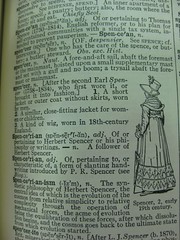
Photos by Harry, noricum, and Greeblie, respectively

Do you find this post helpful or inspiring?
Heck yes I do! 

Comments 5 Comments »

When I moved into my home six years ago, my husband and I went to our local LDS temple. We didn’t know quite how to get there, and we ended up calling someone who didn’t live nearby to give us directions. Because we knew that route, we took it on each visit for the next four years. On a whim, I tried another route one day—and cut the trip by a third.

Frequently when I get critiqued or judged, I get defensive of my work. Granted, all suggestions won’t work for your story, you know your story best, and sometimes critique partners can be just plain toxic. But even bad advice can make our story better when it makes us take another look at our story with a critical eye, when we recognize that just because we wrote it that way, it might not be the best way.

I liked what Katie Ganshert said about this recently about developing skills and editing as an evocative writer:

I want to be an evocative writer. I want to transport my readers into the story. I want to make them feel what the characters are feeling. Which means I spend a lot of time trying to imagine what something feels like, and then trying to figure out how to translate those feelings into words.

Which is exactly what I tried to do when my hero touched my heroine’s arm for the first time. I sat in my chair and I tapped my chin and I tried to think, “What does this feel like? And how can I write this feeling in a fresh way?” . . .

So . . . I wrote: Something warm spread through her arm, as if she’d dipped her elbow into a bowl of hot pudding. . . .

Shannon [her editor] gave me a call and as we were talking she said, “You’re right. That is what it feels like. But elbows in pudding are not appetizing to people. It’s warm, but it’s messy and makes a person feel like they need a paper towel to wipe off their elbow. So what else does it feel like?”

Something in my brain started to click.

She went on to explain that just because a line isn’t working doesn’t mean I’m supposed to delete it. In fact, Shannon didn’t want me to delete it. She wanted me to make the line work. To keep the feeling intact using different imagery. . . .

Pinpointing how something feels is important. But using the right imagery to evoke those feelings is equally important.

This weekend I was looking through some older posts and I came across one from January about gesture crutches. Both of these posts made me think about the same fact:

Just because you wrote it one way doesn’t mean it’s the best way. We should always consider if there’s a better way to say what we’re saying.

I see people defend poor writing by saying it’s their character’s voice. Honestly, I think a lot of the time what they’re really thinking is that “I wrote it that way, so it’s right.”

Maybe. But could you write it better? Could your character say it better? If your character got another chance (or ten) to look at it over again and revise it (for publication), is that how he’d still say it? No, he may not make it poetic and beautiful and use words and images he doesn’t know, but that doesn’t mean he’d leave a mushy sentence there and allow it to undercut his meaning or make him boring and ordinary—and neither should you.

Because why else would we edit? Why wouldn’t we just submit first drafts and companies publish first drafts? Because there’s a better way to say it. And I think (and hope) self-publishing will ride out the same way: you’ll be able to tell who edits and who slaps their first drafts on the market, who says “I wrote it that way, so it’s right” and who says, “I did write it that way, but maybe there’s a better way to say it.”

So, can you say it better?

What do you think? What lessons have you learned from revision (or just thinking about it?)?

Map image courtesy of The Journey 1972 (South America “addicted”)

Comments 2 Comments »

Back when I worked for Marketing Pilgrim, sometimes I’d gather up all the best stories of the week and post a link round up called Linky Goodness. Today I’m bringing it back, but instead of marketing news, I’m linking to awesome posts about writing!

  • We all know writing is a solitary endeavor, and since it’s a second (or third) job for most of us, sometimes it’s hard to take away our precious writing time to seek out other writers—but it’s vital to our well-being! Gabi Pereira of DIY MFA fame talks about Why Writers Need Writer Friends. I especially liked this after attending a conference and seeing all my friends earlier this month.
  • Published author Lisa Schroeder takes a look back at her agent search, saying:

    It was a bit strange to look back to that time – that time when I wondered if I would ever land a good agent and if I would ever have a novel on the shelves of bookstores. And now, three years later, I think about what I would have told myself if I knew what I know now. I certainly did some things right, but I think there are some things I could have done differently.

    I like gaining perspective from people who’ve been there, you know?

  • Author Jenny Martin’s post Voice, the right words is a great take on voice:

    But voice isn’t really about rules. It’s not about passive verbs and misplaced modifiers and too many descriptive clauses. Voice is so much deeper.

    Voice is about letting the characters interpret the action, instead of reporting the events of a story.

    Voice is (and should be!) intimately tied to POV, and this is a great way to do both.

  • In The Danger Zone – When You Go Insane With Editing, Michelle Davidson Argyle warns against going cuh-razy with the edits:

    Danger Zone: When you start looking at the number of specific words in every single paragraph in your book. Too many “thats!” you cry, and start hitting the delete button like a crazy person. You start fixing things everywhere, and out of order. Then you realize that you’ve changed something back there that will affect something up here that will affect something over there. Crap.You’ve created a mess. So you do more editing, and before you know it three months have passed and you should have just rewritten the book from scratch.

    This reminded me of Jami Gold’s post on editing for perfectionists. Personally, I’d like to remain sane.

  • Whether you’re LDS or just have high moral standards, this article on art and morality is very interesting. The conclusion: you don’t have to write dark and disgusting stories about dark and disgusting things to get published. Also, there’s some great advice to all writers starting at “Before closing I want also to say a few words about technique in creative writing.” (story via Elizabeth Mueller)
  • While publishing can definitely give writers a sense of validation, should it matter whether you’re getting a six-figure advance or not? Michelle Davidson Argyle says it isn’t about the big publishing deal.
  • For fun: The Periodic Table of Storytelling based on TVTropes.org. Very funny!
  • Enjoy!

    What’s your favorite post on writing from the last week or so?

    Do you find this post helpful or inspiring?
    Heck yes I do! 

    Comments 2 Comments »

    Agents Suzie Townsend and Joanna Volpe are doing “First Page Shooter” on their blog—participants submitted their first page and the agents are giving feedback on them. And FPS#3 (by Josin McQuein) hits it out of the park with voice. The first line:


    Killing someone’s easier than you think.

    It’s amazing how different that is from:

    It’s easier than you think to kill someone.

    Or

    It’s easier to kill someone thank you think.

    Okay, so maybe people in the publishing industry are the only ones who’d notice the difference, but each line seems to say something different about the speaker.

    What do you think? What kind of person writes each of those?

    Photo by Douglas Walker

    Do you find this post helpful or inspiring?
    Heck yes I do! 

    Comments 1 Comment »

    As I said yesterday, I don’t think there’s anything wrong with writing well in a character’s voice. A character’s voice is not defined by ending sentences with prepositions or using cliches. A writer’s voice is defined by those things—and it’s defined as “lazy.” (Harsh, I know, but I can say it because I know better and I still write that way. Draft that way, at least. Which is fine, really—draft lazy and revise better. But that’s another topic.)

    But at the same time, I don’t want to argue that our character’s voice must always be dictated by the “best” way to phrase a sentence. Here’s a subtle example. Let’s pretend this is dialogue.

    “Can we go inside?”
    “I have no furniture.”

    vs.

    “Can we go inside?”
    “I don’t have any furniture.”

    Both lines convey the same information: character is without furniture. Poor character. But how would you characterize someone who says “I have no furniture” vs. someone who says “I don’t have any furniture”? One is more elegant and efficient—but one is more like how someone would speak.

    Now let’s put that in narration instead:

    “Can we go inside?”
    He glanced at the door. He didn’t have any furniture.

    vs.

    “Can we go inside?”
    He glanced at the door. He had no furniture.

    Which one sounds like a character’s voice, and which one sounds like it’s a separate narrator providing that information? Which one is “better”?

    What’s the point? Although most of the time, we can write in a character’s voice and still write well, that doesn’t mean we have to write “perfectly.” But we should at least know there is an alternative—at least look at the words and the sentences to see if there is a better way of expressing it—before we simply claim “But that’s how my character would say it!” (Yeah, and while you’re at Tosche Station, pick me up an extra condenser coil, wouldja?*)

    What do you think? Which of the examples do you prefer? When do you choose not to use the “best” or “most writerly” way to say something?

    Photo credit: simplybecka

    *Please tell me you get this joke. Please. If not, it’s three seconds—just watch it:

    Do you find this post helpful or inspiring?
    Heck yes I do! 

    Comments Comments Off

    ©2008-2012 Jordan McCollum, except indicated images. All rights reserved.