R is for Revision

I’m gearing up to do the first round of revisions on my WIP. I totally don’t have a system for revision (yet?). I’d really like to do have a set of steps I follow for revisions—instead of still making plot-level cuts and additions two years after I should have!—but I think I just might not be that kind of person. I mean, I can be really faithful about using a datebook, but only for a couple months. The last two months of each of my children’s baby calendars are a major challenge. (Oh wait… Gotta update that!)

Here’s what I do/have done—and I use at least three of these methods at any given time:

  • Make running commentary notes as I’m writing in comments or square brackets.
  • Keep a list of changes I want to make in another document.
  • Keep a list of changes in a sticky-note.
  • Write down ideas on any available slip of paper.
  • Email myself ideas, notes and changes.
  • Reread the completed draft, where I’m only allowed to make notes/comments. (And fix typos.)
  • Complete the exercises in one or more of Donald Maass’s books.
  • Send to alpha/beta readers.
  • Read more craft books.
  • Take time off.
  • Write down character exercises on any available scrap of paper.
  • Talk over potential changes—mostly with myself, since it takes too long to explain everything to give someone else enough context to respond.
  • Lose and/or toss a good proportion of the notes.
  • Print off the entire book and read it aloud, chapter by chapter.
  • Margie Lawson’s EDITS system.
  • Start over at step 1.

Each of these methods can be effective. But still, if this looks like a mess, that’s because it is!

This time around, I’m trying to focus on the plot- and character-level fixes I need first. I went into this book not sure of my characters’ voices (apparently I did something right, though!), or even my characters themselves, and with a plot that was a lot less defined than I usually like. I know the big things I want to improve, but I’m trying to figure out if there are other things I need to fix now (before I get into the more wordy-level things).

I know some people are much better at going about this systematically, and I want to learn from people like Jami, Natalie, and Suzannah. It seems like they have such great “systems” for revising, attacking each problem in order, and they’ll never miss anything. Okay, so that last part is probably just wishful thinking on my part, but wouldn’t it be nice if we all had a single system we could work through with our first draft to make it into something we can really work with?

What do you think? How do you revise?

Edited to add more posts on systems of revision (partially for my own reference): Five types of edits from the QueryTracker blog.

Photo by Joanna Penn

Q is for Questions

Questions can be a great way to get ready to write. We looked at some character questions last week. This time, I want to look at my favorite idea/plot generating questions.

  • What if . . . ?
  • How could X happen?
  • What would it take
  • How can this be more? Do I have any other ideas this would combine with well?
  • What’s the worst thing that could happen?
  • What does this character want?
  • What kind of person would want/not want this?
  • What else is going on in his/her life?
  • Who is the least likely suspect?
  • Who would be the worst/most painful person to do this to the protagonist?
  • Why would s/he do such a thing?
  • How can I get A to do/want/say Q?
  • What other part of the story can I tie this to?
  • Who else is in play here?
  • How can this character have a subplot that parallels the main plot?
  • What else can go wrong?
  • How can I make something go right, but at such a wrong time that it just makes everything worse?
  • Who else is out to get them? Why?
  • What else is going on in this setting? How can that tie in?
  • Can I make things worse?

Sometimes, I find myself just answering these questions subconsciously as I plot and write, but usually I can trace my thought process back through the questions I asked myself to get there.

What do you think? What kind of questions do you ask yourself when plotting?

Photo by Gillian Maniscalco

P is for plotting (and pantsing)

Personally, I think there’s a wide spectrum when it comes to whether or not you outline before you write. Yes, okay, having an outline or not having an outline is pretty cut-and-dried, but there are a lot of in betweens:

  • An idea for an opening
  • An idea for a beginning and a middle
  • An idea for a beginning, a middle and an end (a mental outline, perhaps?)
  • Ideas for several major guideposts in the story (written down?), with room to figure out how to move between them
  • A written outline of the major guideposts and all the transitions between them.
  • A chapter-by-chapter synopsis of the story.
  • A scene-by-scene spreadsheet, possibly including dialogue, setting, exposition.

Once upon a time, I was at the pantser (as in “by the seat of your pants”) end of the spectrum. And my stories were often a mess. (Winchester Mystery Story, anyone?) Whether or not they’d turn out all right was hit-or-miss.

Then I got into a larger project: parallel novels written simultaneously with a friend. We had to work to coordinate our timelines. There was no way to pants this without ruining one another’s books. I broke down and plotted. And to my surprise, it was even better than pantsing!

But while I’m definitely a plotting convert, I’m not a hard-core-plan-every-scene-to-the-final-detail kind of writer. Like pantsers (and probably most plotters to some extent), I need at least a little discovery and creativity to make drafting fun for me. I’m still experimenting at how much discovery vs. planning I need—my last draft was a little short on the planning. It wasn’t until I sat down and figured out my path in a little more detail that I could finish the book. (And I’m going to need to add some more structure in some parts—that darn sagging middle!)

So where do you fall? How did you come to be a plotter or pantser?

Photo by fracacta

O is for being Open to new ideas

No one is perfect—no, not even me, or my critique partners. My CPs are infinitely helpful, and I’ve been blessed with a number of excellent ones over the years. But I’ve definitely seen my fare share of really, truly bad advice. Maybe even a little too much bad advice. I’ve gotten into the bad habit of rejecting suggestions initially.

Sometimes, they really are wrong for my work. But not always. As I discovered a few years ago, sometimes it’s best to:

Weigh it out

This phrasing comes from Josi Kilpack. She points out that no matter how off-base a comment may seem, there may be a kernel of truth in it. Somewhere. And who knows, maybe—just maybe—they were right after all.

I should add here that fortunately I’ve been a victim of this one, too. My favorite example here is when a critique partner suggested I add a scene near the beginning of the book. I hemmed and hawed over this privately—until the scene started playing out in my mind. It was so entertaining—and just like she said, solved so many problems—that I just had to write it, just to see what it’d look like. (And when I still liked the finished product, I stuck it in there.)

I have to stay open to new ideas—you never know when and how your work can get better!

Don’t have critique partners? We have a Story Department here from time to time, just to help develop ideas on all levels. It’s fun—and you can take my word for it.

What’s your favorite way to come up with new ideas?

N is for Novice—Are you?

A while back, someone on my writers’ group posted Randy Ingermanson’s “levels” of writers. (Yes, Randy Ingermanson of Snowflake Method fame.)

Freshmen are novice writers. They often have very fine content, but their craft is unpolished and they usually don’t have any contacts at all. . . .

Sophomores have a bit of writing under their belts. They’ve improved their craft and probably also their content and they’re starting to get restless. . . .

Juniors have gone even further. They’ve become strong writers. They’ve submitted some actual proposals at conferences. They’ve had an editor say those magic words — “Send me that proposal.” They’ve gotten that unmagic letter — “We’ve studied your proposal carefully and it does not meet our needs at the present time.” . . .

Seniors are those few who are ripe to graduate. A Senior is writing excellent stuff. Explosive. Powerful. Moving. But still unpublished. Seniors are worried sick that those mean editors are never going to notice them, that they’ll be submitting proposals forever. Seniors don’t realize that the editors are watching them, hoping to see the perfect proposal that can make it past the committee. Seniors are closer than they think. . . .

(I guess if you’re published, you’re a grad student.)

But no matter what your exact current level, Ingermanson says the key is to be patient. I think I’m pretty solidly a junior—and Ingermanson says he spend eight years at that level. Well, yeah. That’ll help teach you patience. (But I also have kids for that…)

So what do I lack yet? In Ingermanson’s paradigm, it’s the perfect idea. (Sounds a little like a breakout novel. Only a debut. Yeah.) And perfecting my craft.

And friends.

Facebook aside, who doesn’t want more friends? Why don’t you introduce yourself? What do you write, and what level are you at? (I’m Jordan, I write mystery/suspense/thrillers with or without romance, and I’m a Junior. Your turn!

Photo by Mike

M is for Maass, Donald Maass

Two years ago, I’d pretty much exhausted my local library of writing books that looked good, and I knew it was time to knuckle down and buy something. One of my favorite writing craft blogs often drew from two books: Stein On Writing by Sol Stein (which I absolutely cannot find in my house now :\ ) and Writing the Breakout Novel by Donald Maass. Both were great and well worth the money.

Then for Christmas, I asked for and received The Fire in Fiction on my Kindle, and Writing the Breakout Novel Workbook in paper. All of these books have challenged me as a writer, helping me to focus my stories better, deepen my characters, better ground my story in its setting, and more.

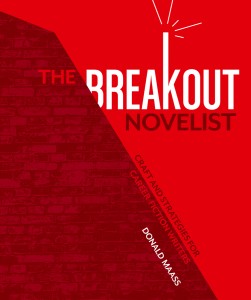
So I was very excited to accept a free copy of Maass’s latest, The Breakout Novelist.

The Breakout Novelist is a combination of some of the best material (albeit slightly abridged) from Maass’s first three books (the above two, plus The Career Novelist, which I downloaded as a free PDF from his site when it was posted there a while ago, but haven’t gotten around to yet).

Naturally, since the source material is good, the result is good. Probably my favorite feature is that all the exercises from the end of each chapter in the first two books have been compiled into two sections of 20+ pages. My other favorite: the book is a hardbound spiral, so it lays flat (I like to read while eating, so this is great!).

I think that it’s probably still good to read the full Writing the Breakout Novel and Fire in Fiction, but The Breakout Novelist is great to keep on hand as a refresher course for each book—and that’s how I’m going to use it. I’m also looking forward to Maass’s posts on writing beautifully at Writer Unboxed.

I received a copy of The Breakout Novelist free for review. However, publishing this review is my choice.

L is for learning style

I was digging through my archives looking for something else when I came across a post that sounded like a really interesting idea. (I can say that because it was a guest post.)

I find that I hit the same senses over and over again, and neglect the others. This happens in writing and in real life, too. I think this has a lot to do with my learning style. During our series on writing the senses last year, somehow I recruited someone with actual expertise to write about how learning styles can affect how we use our senses. Perhaps the most interesting idea is giving our characters different learning styles than we have, and tailoring their sensory experiences to their learning style.

Also beginning with L: this week’s LDS Writer Blogfest. Writers who are members of the Church of Jesus Christ of Latter-day Saints (Mormons) blogged about their favorite address from the latest General Conference. I participated on my other blog. Read all the participants:

Annette Lyon: “Desire”
Annie Cechini: “The Spirit of Revelation”
Ben Spendlove: “The Atonement Covers All Pain”
Chantele Sedgwick: “LDS Women Are Incredible!”
Charity Bradford: “LDS Women Are Incredible!”
Jackee Alston: “The Eternal Blessings of Marriage”
Jenilyn Tolley: “What Manner of Men and Women Ought Ye to Be?”
Jennifer McFadden: “Establishing a Christ-Centered Home”
Jessie Oliveros: “Establishing a Christ-Centered Home”
Jolene Perry: “It’s Conference Once Again”
Jordan McCollum: “What Manner of Men and Women Ought Ye to Be?”
Kasey Tross: “Guided by the Holy Spirit”
Kayeleen Hamblin: “Become as a Little Child”
Kelly Bryson: “The Atonement Covers All Pain”
Krista Van Dolzer: “Opportunities to Do Good”
Melanie Stanford: “What Manner of Men and Women Ought Ye to Be?”
Michelle Merrill: “The Eternal Blessings of Marriage”
Myrna Foster: “Opportunities to Do Good”
Nisa Swineford: “Desire”
Sallee Mathews: “The Eternal Blessings of Marriage”
Sierra Gardner: “The Atonement Covers All Pain”
Tamara Hart Heiner: “Waiting on the Road to Damascus”
The Writing Lair: “Waiting on the Road to Damascus”

K is for Keep on keepin’ on

Yesterday, we talked about jumping in to write. You don’t have to wait for permission or a signed certificate or an engraved invitation: just do it.

Sometimes starting is the hardest part. Lots of people find staring at that blank page intimidating. (Not me: it’s the words that scare me 😉 ). But sometimes it’s not starting: it’s going on.

Good writers make writing look easy, but it’s not. Things worth doing, and worth doing well, seldom are. Writing takes perseverance. Publishing takes even more. It’s easy to get discouraged and feel like you’ll never get this word/scene/book right, or you’ll never get published.

But I like to tell myself the biggest difference between a published author and an unpublished one is persistence. Every athlete and every artist has stories of adversity, whether it’s from opposition from those around them (check) or struggling to better themselves (check). Every time we move past one of those, we get stronger and better—and closer to our goals—as long as we don’t let it defeat us. We gotta keep on keepin’ on.

What do you think? How has opposition helped you get better?