Perseverance

It’s that time again! For no apparent reason, I’m feeling discouraged today—like I’ll never get the WIP that I’ve been working on for almost two years good enough (and nothing else I ever have or ever will write will be, either) (man, the more I think about this the worse it gets!).

And then I come across a little encouragement:

Most people quit when it gets really dark. Those who succeed are the ones who refuse to stop.

from Annette Lyon’s Top 5 Pieces of Advice for Writers

we need to feel good about what we have accomplished without comparing ourselves to others. And that is what success really is – knowing we have done something good and taking appropriate pride in that, without feeling less because others have done more than we have.

from Tristi Pinkston, LDS Author

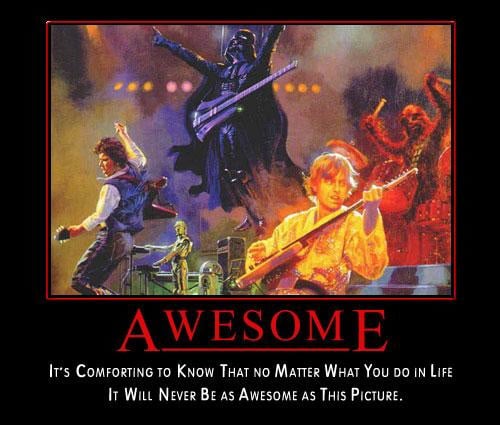
And, of course, to put things in perspective:

Detail of Star Wars painting by Hugh Fleming

The noble goal

It’s been a long time since we talked about creating sympathetic characters, but one of the timeless techniques for character sympathy came back to me last night. We were watching one of our favorite shows, which happens to be a game show. The opening of the show always features short biographies of the four competitors, wherein they almost always predict their ultimate victory and gloat about how much better they are than the competition (whom they’ve never met).

I was all set to really dislike one of last night’s competitors after the usual boasting in her introduction—and then they asked her what she’d do with the prize money ($50,000). She planned to put a downpayment on a home in Brooklyn.

Okay, so that’s not stunning or anything—owning a home has always been part of the American dream. But she didn’t just want a home for the sake of fulfilling the picket-fences plan that’s been programmed into us—she wanted to be able to buy a home in a good area of Brooklyn so her daughter could go to the best school in the city.

BAM! I was on her side in a flash. I was all ready to root against her—until she had a noble goal.

Note that this goal is still kind of self-centered, and not for the betterment of society or anything. But because it’s focused on another person—especially a child (what can I say? I’m a parent, too)—it still helps that person appear sympathetic.

And if it can work on real people, it should work on fictional people. In How to Write a Damn Good Novel, II, James N. Frey argues that a noble goal is key to developing reader sympathy with characters. We need to have a reason to root for the character and hope for his success. Even a despicable degenerate can win readers over if we can sympathize with his goal.

What do you think? What are some examples (from your books or books you’ve read) of characters you didn’t like but still rooted for?

Photo by Robb North

Comparing notes on paragraphing

There is at least one hard-and-fast (mostly) rule for paragraphing in fiction: when you change speakers, change paragraphs. But from there, things can get a little complicated.

If you have a character react to another character’s dialogue without speaking, does that get a separate paragraph? What if the first character continues speaking? Or, to use an example, how would you paragraph this (we’ll call it Exhibit A), assuming it’s the same person doing all the talking:

“That’s the stupidest blog post idea I’ve ever heard.” He scowled at his sister. She rolled her eyes heavenward and sighed, as if begging for the patience to endure him. He took her by the shoulders. “You’re only thinking like this because you’re editing.”

I don’t know that one way is better than another—it mostly depends on what you want to emphasize, and making sure your meaning’s clear. Interestingly, I’ve read a couple books published in the 1950s and ’60s lately, and there seems to have been a rule that every time someone starts speaking, you need a new paragraph, so this example might be:

“That’s the stupidest blog post idea I’ve ever heard.” He scowled at his sister. She rolled her eyes heavenward and sighed, as if begging for the patience to endure him. He took her by the shoulders.

“You’re only thinking like this because you’re editing.”

Which I find confusing, since I think the paragraph change is setting up a speaker change, and it’s not. (And that might be precisely why they’ve shied away from that.)

Along those same lines, I made sure to include (in this totally-made-up-not-for-real example) a sentence that brought the speaker back into actor position before the second part of his dialogue to try to make it clearer who was speaking. (This may or may not be successful. We would assume it’s him because we haven’t changed paragraphs in the first example, but if the sister’s action was the last sentence before the second part of the dialogue, it might be hard to parse who’s supposed to be speaking. While we may want to “challenge” our readers, we probably don’t want to challenge them just to understand what’s happening 😉 .)

And then there’s narrating internal monologue. How do you think you’d do this in Exhibit B?

Terrence looked up as soon as he heard the hollow clack of high heels in the vestibule. Andrea came tripping in to the chapel, casting her eyes about hopefully. Terrence read people for a living. The way she leaned forward, her eyebrows drawn up inquisitively: she was eager to see him. And she only knew him as a lie. He suppressed a sigh.

How about Exhibit C?

Angelica nearly missed the meeting. Why she’d spent so long fussing over her hair was beyond her. No amount of fussing had ever made it behave particularly well—and she shouldn’t be so concerned about how she looked. She was lucky to reach her seat before the presentation began. But she was glad of the fussing as soon as they began the introductions—and she knew Mr. Griggs was there. She hadn’t seen him yet, but she could almost feel his presence. Or maybe his eyes on her.

How would you add paragraph breaks to these examples (if at all)?

Photo by kami68k
The art of paragraphing

Part of the reason why paragraphing is so tough is that there aren’t as many rules governing it—but then, that leaves it open for us to play with paragraphs to great effect. Paragraphing can affect meaning and pace. It’s a powerful tool that I, for one, want to learn to wield better.

One way I’ve found I try to use paragraphs to better effect is to write a paragraph of a character reasoning something out, then break to give the conclusion:

Maria shook her head. Jimmy couldn’t have stolen the diamonds. It wasn’t possible. But the passer-by was talking to the policeman, so they were both innocent. The heiress was in the kitchen, flirting with the maitre d’. And Constantina was returning a book to the public library.

That only left Jimmy.

Note that we still organize paragraphs around the same topic. Here, this set of paragraphs are all about Maria ferreting out the suspect in the case of the missing diamonds. The first paragraph, especially, is organized around a central theme. It could even have a topic sentence: “Maria sorted through the possible suspects.”

And like in nonfiction, there’s a logical progression and coherence among the paragraphs. Here Maria (rather quickly) goes through an actual logical theorem of sorts, persuading herself from the emotional denial (“Jimmy can’t have done this”) to what she knows must be true (oh, but he did).

In reality, I’d break up that first paragraph between “It wasn’t possible.” and “But the passer-by . . .” Which is the exact kind of thing that made me want to write this post: why do we paragraph the way we do? I think in this example, I want to change paragraphs because she’s almost “changing sides” in her mental argument: “A is true” versus “But A cannot be true.”

I could see an argument for breaking there and then joining “That only left Jimmy” to that paragraph, too. It seems to come down to how dramatic we want that conclusion to be. (And I have a sneaking fear I’m an overdramatic paragrapher!)

What do you think? How does art play into paragraphing? How does “art” play in to your paragraphing?

Photo by Windell H. Oskay, www.evilmadscientist.com

The science of paragraphing

How’s that for nitty gritty?

Usually in school, when we learn what a paragraph is, it has a fairly standard definition: three to five sentences, the first being a topic sentence and/or thesis, and the others relating to that topic. The last sentence should usually offer some sort of segue into the topic of the next sentence to show the logical structure of the overall essay. (In the first paragraph, the last sentence is the thesis of your work.) And that’s a great structure—for non-fiction.

In fiction, paragraphs are still important, but unfortunately they’re not quite as easily defined. We aren’t simply relating information or crafting a persuasive argument—we’re trying to make a cohesive narrative come to life.

There is at least one hard-and-fast (mostly) rule for paragraphing in fiction: when you change speakers, change paragraphs. Beyond that, we’re left with . . . more like “guidelines.”

One of those extremely important guidelines is clarity—break paragraphs to make your meaning clear. Breaking a paragraph between speakers is one reason why we do this. We might also break a paragraph to better illustrate the relationship between the character’s actions: showing cause and effect, for example.

Also, breaking a paragraph can help keep POV clear. I thought it was rather clear whose POV we were in in one scene that I wrote, so the POV character could comment on other characters’ dialogue in the same paragraph as the speech. My CPs found paragraphs like the made-up one in bold below confusing POV:

Lisa leaned back in her seat, trying not to look like she was eavesdropping. They were talking about her—again.

“Well, we were going to tell her.” Oh, really? Like when?

As we read, we need white space to help our minds psychologically space out information. We can use this to great artistic effect (as we’ll talk about tomorrow!).

What do you think? How do you paragraph? How would you paragraph this example?

Photo by Xosé Castro Roig

Language and narration

I heart languages. I majored in Linguistics in college, and as part of that I studied two foreign languages. I’m super excited that my library offers free online language courses (and am frustrated that they don’t use more technical terminology. I want to conjugate, darn it!). I transcribe things into the International Phonetic Alphabet. For fun.

But it wasn’t on a conscious level that I began using characters who spoke other languages in my works. I started with a native English speaker—but a native Irish English speaker.

This might actually be trickier than using a foreign language, because it’s easy to forget all the subtle differences between American and Commonwealth English. I mean, I speak English, how hard could it be, right? (Not as easy as you think.)

I think my next project will feature a character who speaks Russian as her native language. This will have more challenges for me because I want to learn all I can about the language to make her voice (in English) more authentic.

For example, in Russian, you can reorder the phrases of a sentence without changing the meaning. “To the store I went” and “I went to the store” are both perfectly acceptable. Moving a phrase to the beginning of the sentence adds emphasis. (So “To the store I went” is like saying “[No,] I went to the store.”)

Which brings me to a dilemma: in English (or just in “good writing”), we tend place emphasis on things at the end of sentences. So what do you think? Should I use the Russian emphasis pattern to stay truer to the way my character would think, or should I conform to the writing standards of English?

And if you have any questions about any of your foreign (or not-so-foreign) characters’ use of language, feel free to ask me!

More fun facts about language and meaning this week from Livia Blackburne

Photo by Eric Andresen

Backstory in perspective

This entry is part 18 of 20 in the series Backstory

If you’ve been here a little while, you know that I’m a big fan of Alicia Rasley (and her co-blogger, Theresa Stevens, of course). I’m knee deep in revisions for the rest of the month, and Alicia goes and posts a great article on backstory. How can I not “reblog”?

A preview (emphasis and image added):

We know we need [backstory], so make it work. Part of the problem is that "layered-on" backstory (that which is meant to make the reader feel sorry for the character or understand some motivation) often ends up just being contrived— the rivets are showing, and the reader can feel the extraneousness of it. "Right, right, she was orphaned and we’re supposed to feel sorry for her. Got it." . . .

This makes the character and backstory work together for coherence. But the coherence requires us as writers taking the backstory we invent seriously, and imagining what it would REALLY cause in this particular person. That is, stop thinking of it as "backstory" and start thinking of it as "her/his past".

Read the rest: edittorrent: Coherence in backstory

What do you think? How can we take backstory more seriously and use it better?

Photo by Todd J

Figuring out the backstory

This entry is part 17 of 20 in the series Backstory

Ha ha, we’re back! I came across a handout from a class on backstory at last year’s National Romance Writers of America Conference.

Author Winnie Griggs says on her handout: “Whether you are a plotter or a pantser, the more time you spend figuring out what makes your character tick, the easier your story will be to write and the more depth it will have.”

For significant events in the characters’ lives, she includes how that event impacts her character’s life-view. The handout also outlines several ways to reveal the backstory (obviously, the full content was covered in the class, and I didn’t attend the conference, so I can’t help you fill in all the blanks).

This handout also features a chart for tracking your backstory against the backdrop of the historical events before and during your novel—an important aspect that we haven’t really discussed. Especially if you’re writing a historical novel, mapping out the events in the years before your novel may help you find some events that could have an impact on your characters.

Using a chart may or may not help you figure out your character’s history and personal motivations. But as I looked over the chart, I wondered how other people come up with backstory details. When it comes to backstory, are you more of a planner, a fixer/grafter or a happy coincidencer? Are you more likely to allow the story to grow out of something that happened before your story starts, or to fill in the blanks in your characters’ pasts as you write them?

How do you craft what came before?

Photo by Earl