Setting is people

This entry is part 5 of 6 in the series Power in settings

Setting isn’t just about people, it is people, too. The society which surrounds your characters can provide the setting, and the conflict.

We see this most noticeably in novels set in historical times or cultures unlike our own, but even in contemporary novels set at in our native culture, society can play a role. Our characters’ family, friends, co-workers, etc., can pressure them to act in a certain way. (Don’t your family, friends, co-workers or society at large pressure you to act a certain way? I certainly feel that way.)

When we limit setting to just the scenery, we aren’t taking full advantage of the time and place we’re setting our stories—even if that time and place are so familiar to us that we don’t really notice them. (Which is my problem with setting in the first place 😉 .) Also, when we limit setting to just the scenery, we aren’t giving our readers the full experience of that time and place. If we’re lucky, our novels will be widely read even outside of Middle America.

We see this a lot in Victorian and Regency novels, which are so focused on society and its role in life. Modern novels may be more focused on the individual, but no man is an island.

And sometimes the modern and the historical collide…

(And I just found out this was actually made by a friend-of-a-friend for a church activity.)

The movie is actually a semi-serious addition to the post: note how much of a role society still plays. Because, hey, it’s Jane Austen.

What do you think? How have you seen society used to create the setting, or how have you done it yourself?

Setting as conflict

This entry is part 4 of 6 in the series Power in settings

In my opinion, the best way to truly make setting a character is to have some conflict for the characters arising from the setting. It may sound specialized, but the setting probably provides opposition to characters’ goals in some form in almost any work of fiction.

In its most obvious form, setting can provide the main conflict of the story, as in disaster fiction. This use of setting always makes me think of movies like Twister, The Day After Tomorrow, or 2012.
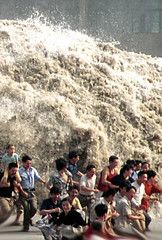
The disaster genre uses setting very effectively on a macro level. A natural disaster—be it hurricane, tornado, earthquake, fire or flood—stands between our heroes and their goals. Often, the heroes’ goal is just staying alive, and, uh, dying really puts a damper on that.

Of course, natural disasters aren’t really characters. They may be the main antagonist in a story, but they’re still no villain. However, we have to establish that the disaster is truly a threat, if not evil (just like with human antagonists). And (also just like with human antagonists), the best way to do that is to show the antagonist in action: someone getting caught by the disaster, or its after-effects or foreshadowing.

Showing the natural disaster’s capabilities can be one form of the other end of the spectrum, a scene-level conflict arising from the setting. This type of setting-conflict is more common, and probably appears in almost any book. It can be something as simple as a traffic jam that makes our characters late for the big meeting.

Sometimes I find myself relying on setting for little conflict like this maybe a little too much, however. A traffic jam or two might not push our readers past their capacity for the suspension of disbelief, but if every time the star-crossed lovers are supposed to meet, the Interstate suddenly backs up, maybe the state DOT should get involved.

Even on a minor level, a simple setting change can increase the tension and conflict in a scene. One dramatic example of this comes from the movie Mr. & Mrs. Smith. If you haven’t seen it, it’s a movie about unwitting married assassins. When they’re assigned to kill one another, they discover their true identities and both question their flagging love and failing marriage.

In one particular scene, they “DTR” (define the relationship). John (Brad Pitt) begins “Let’s call this what it is,” meaning Let’s admit our marriage is a sham. It’s an emotional turning point for the characters—asking is this marriage worth fighting for anymore?

In the original scene, they had this conversation in a parking garage. I’ve seen this version—it falls flat. There’s no tension. It slows down the action side of the story.

Do you remember where they have this conversation in the final cut of the film? They’re hiding under a storm drain grate with the bad guys a few feet away. The characters are not only in a far more tense situation, they’re also forced to be physically close as they confront the reality of their marriage. The dialogue is identical to the originally shot scene, but in this new setting, the tension skyrockets.

What do you think? Do you try to use setting to create conflict? What’s your favorite setting-conflict (that you’ve seen or created)?

Photo by Adam Stanhope

Setting with distant POV

This entry is part 3 of 6 in the series Power in settings

It’s a lot easier to create an emotional response in readers by using your characters’ emotions. But not every scene and not every description is going to lend itself to a character’s viewpoint. Often we see scenes (or books) that start with an almost panoramic view of the setting, as if we’re sweeping through the scene with a movie camera. There aren’t any characters in view, or no characters who can make emotional and perceptual judgments to guide our readers’ responses.

However, we can still use the setting to establish the emotional tone. Instead of relying on a character’s emotional responses and filter to create the tone, we can try to evoke the same emotion directly with the imagery from the scene.

While this technique can be more direct, it can also be a bit more difficult. Manipulating readers’ emotions directly—without getting caught—is a tricky business. (Or maybe I’m just too sensitive—I even resent TV commercials for emotionally manipulating me.)

Obviously, one of the methods you can use to set the emotional tone is imagery. Picking the right image is key, too: focusing on a gray bunny hopping along the forest trail instead of the finger-like, grasping shadows of the trees will undermine the scary tone you’re shooting for. Even if the bunny is important—a “clue,” something you need for later—we have to frame that in the right emotions. Perhaps it skitters nervously down the path, fleeing something unknown, or perhaps we only perceive it as a rustling in the leaves.

Personally, I still prefer using characters as a vehicle for this: by giving them the emotional responses we desire in our readers, we can create those responses more subtly and more easily. But maybe using our characters just helps us to focus our emotional effects, and with care, we can create a tone just as powerfully as we can through our characters.

What do you think? How can we set an emotional tone with a setting, and without characters?

Photo by Hamed Saber

A quick tip on setting (from someone other than me)

This entry is part 2 of 6 in the series Power in settings

I’m not the only one who thinks setting and emotion should go together. Last week, Nathan Bransford linked to some writing tips from author Janet Fitch. And what should we find but this (emphasis mine):

6. Use the landscape

Always tell us where we are. And don’t just tell us where something is, make it pay off. Use description of landscape to help you establish the emotional tone of the scene. Keep notes of how other authors establish mood and foreshadow events by describing the world around the character. Look at the openings of Fitzgerald stories, and Graham Greene, they’re great at this.

Of course, that doesn’t mean that every scene has to begin with six sentences detailing the room, or that a book has to start with a chapter overview on the city it’s set in. It does mean to pay attention to how setting is conveyed. (Like I did with The Cruelest Month, but really, it was unavoidable in that book.)

And I think that using character emotions and perceptions to help set that emotional tone is going to be one of the fastest and easiest ways to create it.

What do you think? How else can we establish the emotional tone through setting?

Setting is about people

This entry is part 1 of 6 in the series Power in settings

Sometimes a setting is so vivid and so involved in the plot—sometimes even becoming an antagonist—that we say the setting is a character in the story. And that’s actually very close to what I think is the truth. No, settings are probably not going to be as dynamic or as influential to a story as your characters will be—but it’s the characters that make the setting.

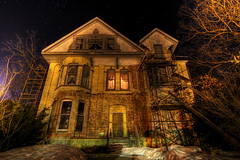
Last time, I mentioned The Cruelest Month by Louise Penny, and a haunted house setting she uses. She sets up some facts and background: people had been murdered there, it stood vacant, they were about to hold a séance there. But those facts aren’t enough to create the chilling haunted house she’s going for.

It’s more than just empirical facts that imbue a setting with a sense of place or make it come to life. Penny also uses emotion to flesh out her settings. To paraphrase characters in The Cruelest Month, this house

  • is the focus of local evil and ill-will, offsetting the good spirits of the bucolic, idyllic village
  • inspires dread
  • has a powerful draw on the characters, despite their dread
  • is the perfect setting for an effort to raise the dead
  • um, is a murder scene. and abandoned. (because the facts do help a little 😉 .)

Describing a decrepit old house won’t be enough to inspire a specific response from your characters or your readers. Powerful settings actually have less to do with the location itself, and more to do with the psychological and emotional effect these places have on the characters. As writers, we can almost always access our readers’ emotions best by using our characters’ emotions. Settings won’t have an impact on the reader if they’re not having an impact on the characters.

Tapping into character’s emotions allows us to connect with our readers. In some ways, the setting’s best use can be to create those emotions and set the mood for a scene, drawing your readers in by inspiring those same feelings in them as they see the setting through our characters’ eyes.

What do you think? How else can setting connect with readers’ emotions?

Photo by Shane Gorski

Setting: it’s not about places

This entry is part 1 of 6 in the series Power in settings

I’ll be honest: setting is one of my weak points as a writer. Sometimes I don’t see settings as I envision scenes at all; other times, I don’t transfer enough of the settings I see in my head to the story on the page. (One of the many reasons I need critique partners!) And when I read, I seldom envision more than just a rough outline of a setting, no matter how much square footage the author devotes to the subject.

In fact, the more time an author spends describing the setting, the less likely I am to 1.) be able to picture it or 2.) settings coveractually read paragraph upon paragraph detailing the historical and architectural details of a location that will never pertain to the story. (Pointed look at a deceased author who shall remain nameless.) (10 brownie points to anyone who guesses who it is.)

On the other hand, I can’t (and won’t) deny the potential power of settings in storytelling and writing. Recently, I read a book that reconverted me to the power of settings, The Cruelest Month by Louise Penny.

The particular setting that she used so effectively was a house rumored to be haunted. The characters hold a séance there, and they reflect on the people who were murdered there. While those creepy details set the stage for a truly chilling setting, they are not enough to create the full effect on their own. (And we’ll finish that thought next time.)

What do you look for in a setting as you’re reading? How do you convey setting as you’re writing?

Picture by Lauren

The ideal e-reader

If you haven’t heard, e-readers (eReaders, if you prefer) are the wave of the future in publishing. With the same experience as reading from paper, e-readers take e-books to the next level (and reduce eyestrain FTW).

I’ve accepted that an e-reader is probably in my future—but suddenly, I realized that future is now: I’m in the market for an e-reader.

I actually had planned this post before I began shopping. I was planning to hold out until my “ideal e-reader” became a reality. (In short, it would be a cross between a Kindle and an iPad, with a touchscreen that could be LCD or e-Ink as needed. Don’t look at me that way—I’m not a hardware person! I don’t know/care if that’s impossible!) But I don’t have to hold out until my iRead dream becomes a reality—I have the money for an e-reader right now.

So if we’re shopping for an e-reader now, the main contenders are the Barnes & Noble NOOK and the Amazon Kindle. It doesn’t hurt that they both just dropped their prices under $200.

Here are the basics: they’re both about the same size. They both use e-Ink for an awesome reading experience (I’ve heard). They both wirelessly download books, including many free books in the public domain. They can both take notes on your books, and can hold about 1500 books, they say.

The Kindle is tied to Amazon. It reads mainly Amazon-tied formats, though you can email some types of files (like Word documents) to a Kindle account and have them converted. (I hear they’re free if you have them emailed back and put them on your Kindle through your computer; there’s a nominal fee if you want it delivered wirelessly to your device). Amazon has an awesome selection and on average, slightly lower prices on e-books. It also has a bubble button “hard” keyboard and can read your books to you with text to speech software.

The Nook is tied to Barnes & Noble. In addition to the e-Ink screen, it features a smaller LCD touchscreen. This is where you find your library as well as a virtual keyboard, and even email and some games. For a few select books, you can loan a book one time to another Nook owner for two weeks. The Nook supports more e-book formats—but not Amazon’s proprietary format. You can take it into B&M B&Ns and sample books for free, up to an hour a piece per book, I think. It also features a replaceable battery and a memory card, so you can expand your library even more, should you ever own more than 1500 e-books.

I still have to try out the gadgets in person (Kindles are at some Targets and Nooks are obviously at B&Ns), but I think I’m leaning toward one right now. Still not totally committed.

What do you think? Would you choose the Nook or the Kindle? What would your ideal e-reader look like?

Sorry, this idea’s taken

As you know, there are only fill-in-the-blank number of plots. Millions of novels have been written in the last few centuries, and before that, there were stories and plays and operas and songs and poems.

Face it: even your zombie-vampire-werewolf-romance-action-horror-tragedy isn’t really new or original. (Though it does sound very tragic.) All the ideas ever have already been thought of. They’re taken.

There are a few things we can do with this news. We can worry about trying to prove it wrong and come up with something so completely new and original and unheard-of that people will stop and stare (and probably run away, because that’s what happens). We can hang our heads and trudge off in defeat. Or we can learn to stop worrying and embrace the idea that there may not be anything new under the sun—but we can certainly put our own spin on it.

I know I often come across the seed of an idea and quickly reject it because it’s been done before. But honestly, some of the most popular and best literature we read today isn’t “new”—it’s an unapologetic take on something that’s been done before, and done really well the first time.

For example, it is a truth universally acknowledged that works like Shakespeare’s Hamlet and Jane Austen’s Emma and Pride And Prejudice are classics, or at least fairly well known. Students and scholars alike study these works centuries after their original publication.

And yet we see “retakes,” adaptations and riffs on these works all the time. And they’re not relegated to the rubbish bin, or automatically rejected because “That’s been done before.” If anything, drawing on those classics seems to have helped The Story of Edgar Sawtelle, Clueless, Bridget Jones’s Diary and most especially Pride and Prejudice and Zombies.

All of those stories use classics as their models, often taking their full plots from the original and simply updating or adapting them. And yet all of those stories stand on their own as well, with new elements and a fresh take (usually) from the author. Just because something has been done before doesn’t preclude you from doing it again with a new spin.

What do you think? Have you ever discarded an idea because it had been done before?

Photo by Thomas Levinson