Website review: Becke Martin

Um, so I wasn’t thinking so hard when I only posted two critiques last week—so this week we’ll have four reviews, and then take a look at our favorite author websites.

First up this week, Becke Martin‘s beautiful site!

becke

Kathleen’s comments

Dear Becke,

This is a fantastic, beautiful website! Your colors are pleasing and cheerful—but I’m not sure you’ve effectively portrayed and advertised what you write at first glance.

Both your catch phrase and your site’s graphics led me to believe that you wrote either humorous, passionate, romance, or light-hearted chic lit romance. Therefore, it caught me by surprise to read that your books have magic and mystery, and that you write romantic suspense. This means that your best potential readers, those looking for romantic suspense, might click away as soon as they see that big cheerful sunflower and get the impression that you DON’T write romantic suspense. Do you see the problem?

I think you’ll have an easier time reaching readers if you redesign the colors and graphics on the site to look less like a country kitchen and more like the world of your books.

I also think that you should adjust your catch phrase. Even adding the word “magical” twist would help, though it still makes it sound more like Sabrina the Teenage Witch than romantic suspense.

Finally, the image that (I think) replaces your “Welcome” word on the home page isn’t showing in Firefox. [Note: it’s showing on my Firefox . . . not sure why that would be different—Jordan]

Your content layout and blog integration are fantastic. So I think that once you match the look of the site to your genre, you’ll have a top notch website. God bless!

—Kathleen MacIver, KatieDid Design

Jordan’s comments

What a beautiful website! While I do agree with Kathleen, I also want to point out that you’re doing so much right here. You’ve made your website fun—including with an ongoing contest.

You’re using your books and news page to highlight not only your works but the awards you’ve won (and you even link here—I’m flattered). That’s a great way to show off your works and your awards to prospective agents, publishers and buyers. (As always, of course, I think 5-7 polished pages of a story can highlight your work really well, too.) As Kathleen mentioned, your blog is integrated perfectly with your site.

Your search engine presence is good—your site is #1 for your name on all three search engines. Your MySpace, Twitter, guest blog posts and other blog mentions also rank in the top ten. One thing you could do here is add a meta description to your site—often search engines use that description as the text underneath the link in their results.

A couple technical comments: when I view a blog post, the page looks really strange (the text is all off to the side very far). Also, on the homepage sidebar, where it says “Check out my blogs,” I expected it to be a link. On a few pages, I’d like to see the text (or lists of links) categorized or accompanied by explanatory graphics—long lists of links or blocks of text can make web readers’ eyes glaze over.

I see that your website was done professionally, and I assume you had input in the process—so you tell me, Becke. What were you going for with your site design?

Hope this helps!
Jordan

What do you think?

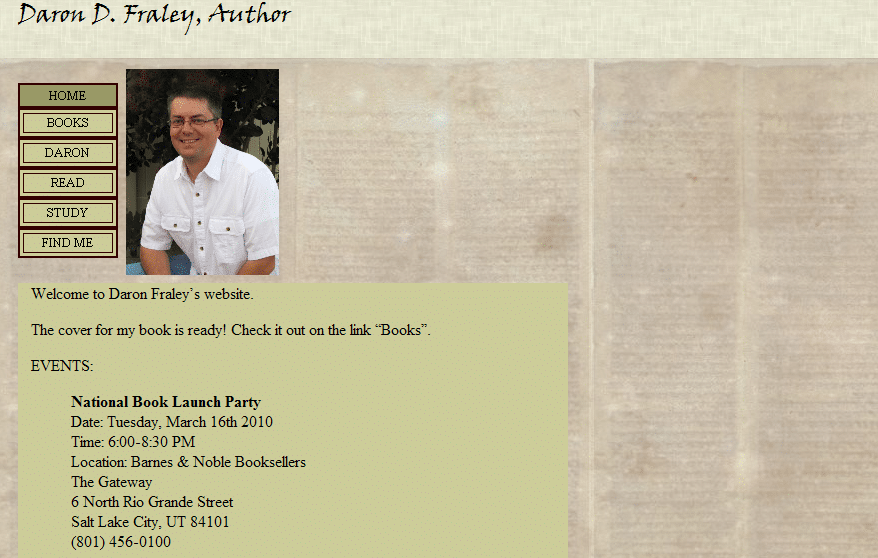
Promoting your books with your site—Daron Fraley’s review

Today, we’re looking at the site of an author whose first book is due out in a few months: Daron Fraley. It’s time to get ready for promoting that book! (Also note: I posted the answers to yesterday’s quiz.)
daron

Kathleen’s comments

Dear Daron,

I like the paper-looking background on your website. You’ve got a great author photo, too, which is a nice, personal touch. Your site is very simple, which isn’t necessarily a bad thing.

What would I suggest when you’re ready to make improvements? Well, the first issue is that your site doesn’t sell or advertise your book. It says it’s coming out soon, but the home page doesn’t say what it’s called, nor what genre it is, nor the publication date (and where it will be available), etc. You want to get all of this on your front page in an easily read and understood way. If the book will be available through Amazon, then as soon as a page is up for it, make sure you link to it!

Hopefully, the cover art is such that an image of it will show the genre…but even so, it would be great to have a catch phrase or mention of the genre up under your name on every page of your site.

Second, there are many different layouts and templates, etc. that could improve the site, but it’s hard to know what you would like. Therefore, I’ll mention improvements for THIS layout and look.

  • How about a graphic that matches your genre? Back in the first series of website reviews that we did, (and which Jordan has created a PDF of) I talked about how you want your website to give the visitor the impression that they’ve stepped into the world of your books. I’m not sure what limitations your website account has, but anything that will move toward this goal will increase interest in your books.
  • Right now all of your site content is shifted to the far left of your site, which makes it look a little lop-sided. If you can center the content section so the blank space to the right is split between the left and right, that will really help the pages look more balanced.
  • The Study page should, I think, show the connection between the Bible studies and your story. As it is, I think I understand, but I have to look on two pages (the books page and the study page) to figure that out. That might confuse those who happen upon your Study page first (through Google). Instead, you want those who are googling these things and finding your page to instantly KNOW that you’ve written a book that they might find interesting!
  • Your Find me page could be snazzed up a little by adding one of Twitter’s widgets there, so it shows your last number of Tweets. Take a look at my twitter page for an example. Twitter will walk you through getting the code.
  • The blog template that you chose is gorgeous. If you can adjust the colors of your website images (and the solid color behind your text) to match the blog images better, that would help them fit together. Then see if whatever graphics you add to your site can also be added to your blog. At the very least, add a book cover image to the top of one of your sidebars.

I hope this helps, and God bless!

—Kathleen MacIver, KatieDid Design

Jordan’s comments

Hey Daron! As usual, Kathleen is spot-on. In the last series, I also had an article on how you can use your site to help promote your book, and there are a number of suggestions there, including the ones Kathleen made, excerpts, and trailers.

But since she covered that so well, I’m going to move on to more technical issues. Your search engine presence is good for your name—with a unique name, you should definitely rank well. However, your site itself is #4 on Google and Bing (#1 on Yahoo, though)—it could be better, and it’s competing against your blog (which is winning on Google).

I ran your site through a simulator to show what a search engine spider would see when looking at your site:

Spidered Text : Daron D. Fraley, Speculative Fiction Author

Spidered Links : No spiderable links found.

Meta Keywords : Daron D. Fraley, The Chronicles of Gan, The Thorn, speculative fiction, author, writer, adult books, Gan, Valor Publishing Group, Christian fiction, fiction, YA books, Daron D. Fraley, Daron Fraley, Daron, author Daron Fraley

Meta Description : No meta description found.

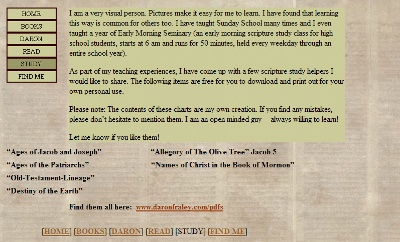
Thankfully, search engines are slightly smarter than this, and they have been able to index your site’s content. But the underlying problem here is that your site uses frames.

For those that don’t know, frames split out the content of a website into different “windows” or panes on a browser page. (Once upon a time, there were actual bars between the frames.) The actual code for the page only refers to the other files that have the actual content on them, adding an extra step for search engines.

Frames are also hard on users. For example, if I wanted to link directly to your Study page . . . well, I just couldn’t. When I go to the Study page, the URL in my browser is still “http://daronfraley.com.”

Rather advanced users of a web browser can still find the URL of your Study page by right-clicking on the navigation, but if we follow that URL, the page we come to has the top header of the site (the other “frame”) cut off.
daron2

The solution: it’d be really easy just to leave frames behind altogether and put the code for the header into the individual pages or the template for your site.

Also note, the meta description will serve you better than the meta keywords (which aren’t used by most search engines anymore—but the descriptions may be used as the snippet below the blue link on a search engine result page). Finally, links will help pull your rankings up. I also recommend hosting your blog on your domain (at blog.daronfraley.com), which can also help your link authority in search engine’s eyes.

As always, I also recommend having a way for site visitors to contact you directly, preferably a contact page with an email form. It’s great that you have the social media contacts, though, making sure that people can find you around the Internet (and your Twitter profile, Facebook profile and blog are prominent in the search engines, too).

Finally, I do want to tell you that you have great content on your site. It’s rare that an author has stuff on their site that could be truly useful (and at least somewhat related to their works) like your study helps. Sharing short stories also helps prospective readers to get a taste for your writing. It’ll just take a few tweaks to help your website better represent your book and work for you!

Hope that helps!

What do you think? How can authors promote their books on their sites? What authors have you seen doing this well?

Photo credit: excited reader—Chris Johnson
Quick website quiz

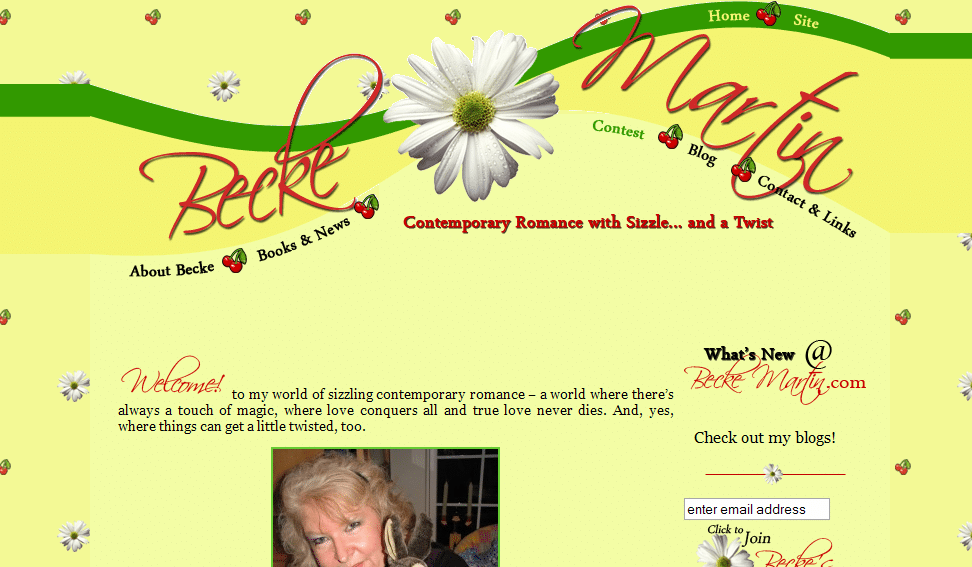
In yesterday’s website review, Kathleen mentioned how important it is to convey your genre with your website. It can be hard, depending on the genre. Even some published authors’ sites don’t do it well.

Quick: Can you tell me what genre these published authors write in? (I took the name off a couple and removed outright genre identifiers because that would be too easy, and that’s not what this is about—it’s about looking at the graphics on their site to see if they convey their genres. If you’ve read any of them or recognize their sites, try to judge only by what you see here.

Links and answers to be posted in the comments!

1.)quiz1

2.)quiz6

3.)quiz2

4.)quiz7

5.)quiz 3

6.)quiz4

7.)quiz8

8.)quiz5

Post your guesses in the comments! The person with the most answers right (without cheating) will win . . . something!

Highlighting your works—Michelle Jefferies review

Thanks to everyone who offered encouragement yesterday! And now, oh frabjous day! We’re starting our latest series of website reviews by me, Jordan McCollum, of here and Marketing Pilgrim, and Kathleen MacIver of KatieDid Design—today with C. Michelle Jefferies’s website.

michelle

Kathleen’s comments

Dear Ms. Jefferies,

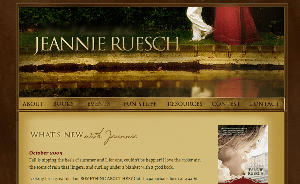
I like this site! It clearly portrays the idea of stories and words, and the use of quotes establishes the genre, to a small extent. Your navigation is also clear and easy to follow.

Here are some suggestions that might help bring your site to life just a bit more:

  • If you want to improve your site, I would try to add just a bit more color, perhaps, just to make the site not feel so cold.
  • The Japanese/Chinese (I’m not sure which) characters effective hint at the genre, but it might be nice to know a little more. Are these YA? Adult? Romance? Adventure? Children’s? If you can find a way to portray that so your visitors can know if the first 3-5 seconds on your site (without looking for it), that might help.
  • However, the “hit man” quote on the top of the Why Butterflies page didn’t fit the whole idea of Asian fantasy that I got from the front. That leads me to think that my Asian fantasy perception is not accurate…which means that you DO need to clarify your genre better.
  • How about a great author photo? 🙂
  • Your My Books page is hard to follow. Some paragraph breaks dividing each book and series would help. Some book covers would be great as well.
  • Your Why Butterflies page confused me. Also, at the bottom you have the word, “Meramorphosis.” Is this a word I don’t know, or a typo?

I hope this helps, and God bless!

—Kathleen MacIver, KatieDid Design

Jordan’s comments

Hi Michelle! I do like your site design (though I’d like the gradient background on the right to repeat down the length of the page).

As always, I recommend getting a domain of your own, and putting your Blogger blog and website on that domain. Both michellejefferies.com and cmichellejefferies.com are both currently available—I’d tend toward the one without an initial since it’s that much easier to remember and get it right. But either are better than your current URL—all people would have to do is remember your name, not your name and a domain.

Search engine presence

Now, I do assume that many people won’t remember your first initial when searching for your name. Without the C, there is some bingsadcompetition for your name, and Bing can’t find you at all (not terribly surprising). Google ranks your site as #5 and your blog as 8 (your Twitter profile is between those). Yahoo ranks your blog as #1 and your site at the 8th and 9th positions.

Now, with the C, your presence is better. Google and Yahoo have your blog and your site in the top 3. Even Bing finds your blog—putting it in the #3 and 4 slots. Other relevant results include your Twitter, Facebook and Listorious profiles.

This shows that you could probably work some more to build links to your blog and especially your site, but you have a decent start.

Pages

I agree with Kathleen on your My Books page—your site could be working harder to show off your works and your writing. The list of titles and statuses doesn’t tell us a whole lot about the stories you’re writing. I agree that book covers will liven the page up (although I think designing one’s own covers for an unpublished site is hokey, I did it because a page of text is boring).

I also agree that a paragraph format would be helpful—but with that many WIPs, it could easily be overwhelming. In fact, it already is—fifteen novels in various stages of planning, writing and revising is simply too many for most people to wrap their heads around.

I think the best strategy would be to select the best works—the ones you’re actively pursuing publication on now, plus a few to show depth—to give a quick summary of and put together mock covers for. Also, while you have a very short excerpt on the front page, I think adding one or two short (up to 5-7 MS page) excerpts from your edited and polished works (on separate sub-pages) would let visitors get an even better taste of your works.

On your Biography page, I would add your awards. You use “Award winning author” as your tagline, but you only have an award mention buried in the My Books page. I would recommend highlighting that award prominently in your Biography page. That award will set you apart for readers and more importantly publishers. Finally, as always, I recommend adding some more social networking info—promoting at least your Twitter profile (probably on the Blog & Email page, which you might then rename Blog & Contact).

We hope that helps!

What do you think? How does your site highlight your works and your writing?

Photo credit: highlight&dmash;Daniël Cohen

What makes a writer?

Sorry about the long break there—I was sick. I’m back and all better, I hope—and tomorrow we should start the website reviews!

I suppose I should start with a confession—I haven’t written fiction in almost two months (aside from rewrites in last month’s revisions). This is partially because I’ve been sick for almost two months, and that’s actually making it harder than normal to cope with this lack of creativity.

I also haven’t been editing a whole lot, though I did perform major surgery on my last MS. I simply lack the motivation to do most writing related tasks (or, let’s face it, get dressed half the time).

That’s the biggest problem, really. Combined with a protracted illness (which, really, really, should go away any month now, please get the memo, body), though, I find myself doubting whether I can classify myself as a “writer.”

After all, the great practitioners of the art tell us, a writer is someone who has to write. A writer writes every single day. A writer is disciplined to write no matter how s/he feels.

And actually, this is actually a rather minor condition—it’s not like I have a terminal illness or something. People turn out better writing than I ever have feeling worse than I ever have.

So what’s the matter with me? I’m supposed to be a writer. I’ve finished three novels in the last year. When I’m drafting, I write whether I feel like it or not. I’m supposed to be better than this.

I actually do believe we need to make allowances for ourselves, especially for health. Overcommitting isn’t going to make me a better writer, and burning myself out when I already don’t feel good isn’t exactly a good way to prove my commitment to a career. Is it?

What do you think? What makes someone “a writer”? How do you handle time away from writing?

Photo credit: writer’s block—Jonno Witts

How did you learn to write?

Most writers, of course, learned to write in school—the teacher stuck a pencil in their hand and showed them how to form the letters. Another teacher later on taught them about words and sentences and parts of speech and punctuation.

Of course, everyone learns those things, and not everyone goes on to want to be a writer. Personally, I learned a lot from writing—a lot. I wrote all through high school. I wrote in my freshman year of college, and then I drifted away from writing for several years while I finished school, got married, and started my family, though somewhere in the back of my mind, I still wanted to be a writer.

And of course, I’ve learned a lot in other ways as well. Writer’s conferences are a lot of fun and extremely useful, but most of the time aren’t designed to hit the techniques very hard (unless you go to a more one-on-one track). Critiques from trusted friends (and strangers!) have been invaluable.

And then there are the books, of course. I hit the public library and read almost every writing technique book they had, my favorites being How to Write a Damn Good Novel and How to Write a Damn Good Novel, II by James N. Frey, and Writing the Breakout Novel by Donald Maass, among others that escape me now.

But honestly, even these things are kind of advanced—they don’t, for example, cover basic things like showing vs. telling. And, um, I’ve kind of forgotten how I learned that.

So how did you learn writing—the basics and the advanced stuff?

Photo by Schmorgie13

Character arcs and gender

This entry is part 8 of 11 in the series character arcs

We were done with our series on character arcs, but then those pesky comments had to butt in again 😉 . Murphy, an awesome commenter and thinker from the community at Edittorrent, left a very insightful comment about characters who do and don’t arc last week, which I think could prompt some good discussion today:

I was wondering about the difference between the male emotional arc vss the female. We think, process and communicate in a totally different ways—so shouldn’t the way we plot these arcs—reflect that? And doesn’t this tap into the POV issue at some point? Hmm…I’ll have to think about.

I think that the exact starting and ending points of the character arc should be suited to the character and the story—and gender, of course, will play into who the character is, in the sense that it plays into all of our selves and self conceptions.

Generally, however, I prefer to think of my characters on a deeper level than to generalize by gender—yeah, guys communicate one way and girls another, but more important to me is who these people are as individuals, not as a man, or as a woman. (Genre and plot, of course, can also play into this—in my latest WIP the male variety of fear of failure got to play a bigger role in my POV character than normal.)

In character who do arc, I think the basic pattern will always be the same—start at one extreme, lacking something (internally), be forced through external events to confront that lack and try new ways to alleviate it, and finally come to the reversal (and prove the change) at the climax and/or conclusion, where they’re now at the other extreme.

But the exact characteristics that they will change and the exact events that will make them change will vary depending on the character. And these may be dictated by gender—most likely, you’re not going to see a woman in a romance be the one to confront her own commitment issues. But at the same time, successfully bucking the conventions can be awesome, and in some ways, almost a requirement.

So what do you think? Are character arc patterns universal? How does your character’s gender play into your choices for their character arcs?

Photo by Bianca