This post originally ran on Romance University last year.
We all know we’re “supposed” to have a website if we’re pursuing a career in publishing—but we’re not all sure exactly what we’re supposed to do with it! Today, we’re adding seven more secrets of successful sites—what your website must be:
Findable
 Bottom line: a website’s no good to you if no one can find it. Make sure your website doesn’t block search engines, or put up any barriers to them finding your site. Links to your site with your name as the anchor text (the text of the link) can help search engines to find and rank your site for your name.
If possible, YourName.com or YourPenName.com is the best address for your site. Lots of free hosting services (including Blogger) will let you redirect your site to YourName.com (some for a modest fee). If YourName.com is taken, try to get something as close to that as possible by using initials (especially if you’re using them in your credits) or an extra word such as “author,” “writer” or “books.” Note that hyphens, i.e. Your-Name.com, are used less often and can be harder to remember.
Useable
Visitors to your website should be able to navigate easily and find what they’re looking for. Use an easy-to-understand set up: generally, websites have navigation links horizontally below the header and/or on the right or left sidebar. Also, think carefully about what you call the various areas of your site. “About me” or “Biography” is a lot easier to find and understand than “Everything you ever needed to know” or “100 things.”
Shopable
Imagine you’ve just finished a book by a great new author and you head to her website to see if she has any others. Great, she has some listed—but how can you find them? She doesn’t say! Are they out of print? Do you have to order them through her? (How?) Should we resort to Amazon? Ooh . . . pretty books . . . what was that author’s name again? Ooh, sale!
Give your website visitors an easy way to get more of your books—give direct links to your books where they can buy them.
Shareable
 If you want your visitors to tell their friends about your site, make it easy on them. Include links to email articles from your blog, or share them on Facebook and Twitter. But even more important than making it easy to share your site is making your site worth sharing. Give your visitors an experience they’ll want others to have, whether that’s laughing, loving or learning, and then give them a way to share that experience.
Professional (yeah, I ran out of ables)
This site is your business card, your TV commercial, your sales flyer and your public persona all rolled into one. Being professional doesn’t mean being stodgy, but it does mean putting your best foot forward in attitude and appearance. Match your design and your writing style on your site to your chosen genre. You can be funny (even irreverent!)—and you should be if you’re writing humorous books—and still be professional.
(The same rule goes for your interactions all over the Internet!)
Informative
One of my pet peeves is visiting “thin” sites: sites with almost no content or information. You don’t have to be the next Wikipedia, but you should have enough information to draw visitors into your site, let them know who you are, maybe even let them see what you’re working on. One of my friends had an editor approach her about her book from what the editor read on her website. If you have your first pages or chapter polished for a contest or querying, I think it’s a good idea to make them available on your site as well. And don’t forget your About page—let us get to know you!
 Fun!
Fun!
A fun site doesn’t necessarily mean you need to hire somebody to create a bunch of animated games tangentially related to your works. A “fun” author’s site should include bonuses. It could be games or contests, or it could be something as simple as deleted scenes from a published book. If you’re lucky enough to have a group of dedicated fans, help them to interact and build a community (and don’t forget to participate!).
Conclusion
Whether you’re preparing to query or publishing your pentology, your author website can work for you and for your visitors. By making sure your site is findable, useable, shopable, shareable, professional, informative and fun, you’ll create an experience your website visitors will want to repeat, whether they’re agents, editors or readers.
What do you think? What else do you look for in an author’s website, and what are you striving to do with yours?
Photo credits: frustrated—Sybren A. Stüvel; asleep at computer—Aaron Jacobs; loving your site—Chris Champion
 After your book has been accepted for publication, your website is an even more powerful tool. If you’re still solely on a blog on a free domain (i.e., ilurvewritin.blogspot.com), it’s time to buy your own domain, preferably YOURNAME.com. And along with a new domain, this is a good time to upgrade to a “real” website—keeping your blog, of course, but also hosting a stable website—or at least a blog with a full complement of pages. Ideally, the blog and the website design will be integrated seamless.
 How can I do this? Well, along with the above ideas, it’s also a good idea to spread the word on other websites through advertisements, reviews, releases, contests, and other publicity.
 A community based around a blog, forum or website means that people feel welcome. People can participate and interact with you. People come back.
  While you’re preparing for publication, it’s also a good time to get your web presence ready—especially to find the niche where you’ll fit in the blogging and publishing (and publogging?) worlds.
  How can I do this? Professional appearance—check out advice from professional website designer Kathleen MacIver of
  However, do not use your website as the only medium an agent can see your query or sample pages, especially not if they ask for any writing from you. An agent or editor will expect you to email them words (either in the body of the email or as an attachment)—not a link to their website. Never make an agent do more work for your writing when they’re interested. Odds are good that they won’t follow links.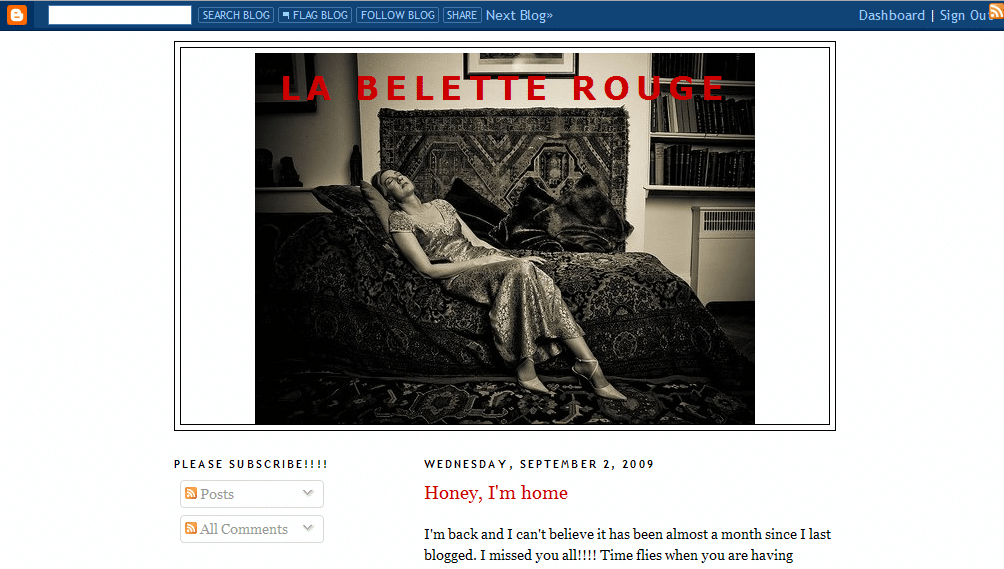
 I’ll ask you the same thing I asked a few other blog owners . . . what is the purpose of your site? What is your goal? If yours is community (which you seem to be doing excellent at fostering), then I think your community would attract new participants more easily if your site clearly states what your community revolves around.
  There may be a good reason for this. If you’re purposefully blogging under a pseudonym, and you want it keep it that way, you may want to keep potential publication info away from your site so you don’t get your real name associated with your site. (Then again, maybe you should be writing under a pseudonym, too.)
 Also, your sidebar is quite long. I really like that you’ve been highly selective about what badges and honors to display. However, there are still a lot of links there. When visitors come across a long list of links, their eyes are likely to gloss over—they can’t focus on any single link, so they don’t bother looking at any of them. (A lot of links on a single page may also dilute the value you’re passing along to the sites you link to, in search engines’ eyes.)
 Because your main page is so heavily based on graphics, it might be a little hard for search engines to understand. One
  One thing going for you is you have a sitemap. Generally, that’s a good way (albeit a last resort) to help users and especially search engines find the content on your site. However, when I clicked on the sitemap link, it was broken.
 It’s not enough to make sure that the site makes sense from the home page, because very, very few people enter a site by the front door. We can’t even count on people who find us through a business card or bookmark entering through the front door because an unbelievably large percentage of Internet users think that URLs are supposed to be entered into the search engine bar of their browser. They don’t even know that URL bar exists up there! [Aggravating, but true: Google searches for “amazon.com” and “google.com” are amazingly high, and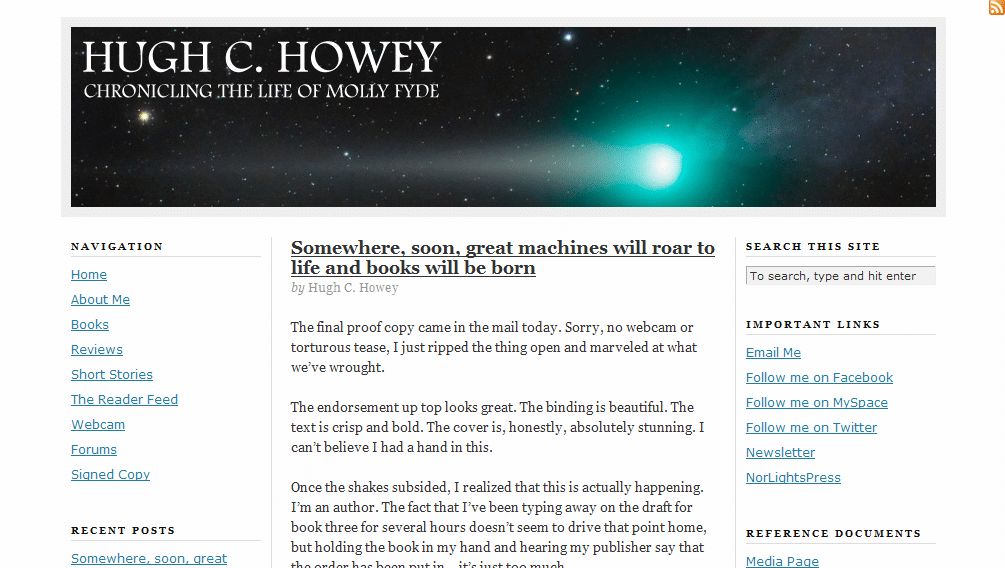
 Think about why your readers will be coming to your website. Will it be because they’re interested in your book and want to learn a little more before they buy? Will it be to learn more about the author? (You could probably help them out a little more there 😉 ). Will it be to learn more about your next book? Will it be because they’re reviewing your book for their blog or newspaper? What are they looking for? Help them to find it—and make their paths to their goals clear.
 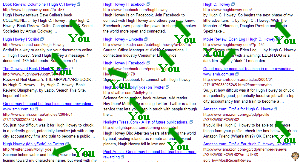 For [Hugh Howey], your site ranks #1 and #2 on Google, and #1 and #3 on Yahoo. Awesome! Bing, as always, is evil. They have your Facebook profile first, followed by LinkedIn, Facebook again, Twitter, your publisher, two articles about another Hugh Howey, and your profile on Asimovs. So apparently they don’t just hate Blogger blogs.
 Finally, what else can you do to bring your visitors into your world? Make your website a window into the world of your books. Draw them in, so they just can’t help wanting to know about the characters in your world. This might mean re-designing a new home page that focuses on your characters and your world, instead of your blog…that way, when you post reviews on other products and books, your visitor’s first impression is still on YOUR book, instead of someone else’s. Feature your book covers on your home page…maybe overlap that nebula image with a small photo of each of your books tilted on edge, so there’s an instant sales pitch in one glance. If not there, get those covers somewhere on the home page!