Want to learn more about plotting or creating effective character journeys? Check out my free writing guides!
When I first heard the terms “plot driven” and “character driven,” I immediately wanted to classify my work as the latter. The term “plot driven” makes it sound like our characters are jerked around without motivations or any other reasons save it be that “I, the author, need you do to such-and-such.”
That’s not my story, we claim. In my story, the characters are the driving force. They make the decisions (based on the motivations which I carefully crafted for them) that bring to pass those plot action. They are more than just cookie cutter cardboard characters who get jerked around like marionettes. 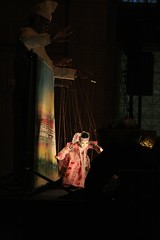
This usage is so common that I feel bad for imposing the prescriptivist label of “wrong” on it, but I want to note that there are more than one way that these terms are used, and if you’re using these terms, it’s really important to understand how other people are using these terms.
At Edittorrent a couple years ago, editor Theresa Stevens defines these terms—and reminds us that they’re not mutually exclusive:
Most writers use both character and plot to drive the story forward. Keep that in mind as we go through the ideas in this post. It’s not an either/or. It’s a sometimes this/sometimes that/sometimes a blend of both.
In the simplest form, here are two definitions.
Character-driven: When something about the character’s essential self leads to a particular action or event in the story.
Plot-driven: When a character takes a particular action so that the result is a particular plot point.
 (A little too abstract? Theresa gives a good example in the post.)
These definitions work on a macro level as well. When the basic story is driving toward a particular event or plot outcome, that’s technically plot-driven. When the basic story is more about the character’s internal growth and change, that’s technically character-driven.
Many genres of fiction, including mysteries, thrillers and romance, are inherently plot-driven. There is a set outcome: finding and stopping the bad guy, happily ever after, whatever. There is a perscribed plot formula—and if you violate it, writer beware.
However, as Theresa notes later in the article, these formulaic genres also have a specialized use of these terms. In romance, for example, there is both an internal plot (the romance) and usually an external plot (which might be a mystery or basically any other type of story). These plots influence one another an interact.
The internal plot, the romance, has a set outcome: happily ever after—like a plot-driven story. But the plot itself has more to do with the character’s inherent attributes, growth and change than about specific events and actions, like a character-driven story.
Conversely, the external plot, often does not have a set outcome: can they fix up this old hotel? Can they win over his domineering invalid mother? Can they overcome their business rivalry—or might they both lose/quit their jobs? This plot line is driven by events, making it plot-driven. But without a set outcome, it may or may not ultimately be a plot-driven storyline.
Confusing enough for you?
The bottom line, however, comes straight from Theresa:
Now, you’re probably wondering why this matters. Who cares if your story is plot-driven or character-driven? The truth is that the technique will not show in the final manuscript. When I read a book, I can’t tell if they started with a character or an event. And I shouldn’t be able to.
 You can start with a character and generate events that suit him or her (as long as those events eventually become a coherent plot). Or you can start with plot and generate a character that suits it (as long as that character eventually becomes a consistent, rounded person). But whichever you use, the end product should most likely have both external plot and internal conflict and growth—coherent plot and rounded characters, character growth and motivated events.
(Important exception: literary fiction may be external plot optional . . . but this may or may not be why literary fiction gets a bad rap from time to time. However, character-driven plots are usually the most important aspect in literary fiction, tracking a character’s emotional journey and change.)
Want to learn more about plotting or creating effective character journeys? Check out my free writing guides!
What do you think? Do you start with plot or character? Can you tell what others start with?
Photo credits: marionette & puppeteer: Asian Art Museum; dash & wheel—Ted Fu; steam engine drive shaft—Matthew Hine
 have some sort of mental disorder (or live a very different life from me!), this rule leaves no room for fantasy, science fiction, paranormal (well, I suppose that one’s debatable). There would be no Shakespeare or Twain (well, a lot less Twain, anyway) or . . . fiction, when it comes down to it.
 Now, I’m going to tell you right now: that’s quite often good advice. I’m not one for slavishly adhering to rules, but when I read a book that routinely tells me about what people are thinking rather than showing me that they’re thinking it, it drives me crazy. It’s like reading about a story rather than reading the story itself.
 In this case, we really don’t need to “see” every detail of the children’s clothes. Now, a better way to accomplish both might be for the character to actually handle the children’s clothes, noting the details (perhaps she’s a seamstress who appreciates clothing construction and patterns?), her thoughts slipping back to her son.
 Thee problem is this: there’s only a handful of words in the English language to express those actions: smile, beam, grin, smirk, simper. Nodding is even worse: nod. Other versions of this one tend to draw attention to the words instead of showing the characters’ actions: bobbed his head (“up and down,” if you want to make it even more annoying).
  And do they need the forbidden modifier? I think so. Can you infer the meaning of his grin with just “He smiled at her”? (I have two images in mind here: “He smiled at her. Mmm. Lunch.” and “He smiled at her. Oh, a friend.”) A thumb chewer may be a small child seeking comfort, an adult pondering a problem or a guy with a nervous habit.