Becoming a story architect

This entry is part 3 of 24 in the series The plot thickens (Mwahahaha)

I think most of us have to try a few Winchester Mystery Stories before we’re ready to become story architects.

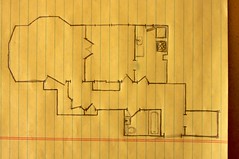
floor plan sketchI really like the analogy of architecture here because I like floor plans a floor plan isn’t a complete house. It’s a sketch of what you plan to build. It’s an easy way to look at a scaled-down model of where you think you want the major rooms to go, where the appliances will be, where the doors are, etc. It isn’t your house.

The floor plan can change even after you start building your story. Sometimes we “remodel” as we “build”—we decide this doorway should be a window and the front entrance should go here. We change the door to a double door; we upgrade the A/C or the wiring; we knock out a wall and add a new bathroom. We scrap the entire second floor.

Having a floor plan doesn’t mean we have to build that house—or even that we’d all build the same house with the same floor plan. But having a floor plan means we don’t end up six months into the project with 123 bedrooms, 16 dining rooms and no kitchen or bathrooms.

On the other hand, the floor plan is just a basic sketch, which can be improved upon, revised, and changed during the process of writing. In fact, you probably wouldn’t recognize the house just from the floor plan.

For me (and others), the floor plan is such a basic sketch that once we’ve gotten that built, we still have a long way to go before we have a finished product. Once we have the events down in the first draft, we still have revising and finishing to do—furnishing, painting, decorating, accessorizing (moving all our crap in πŸ˜‰ ).

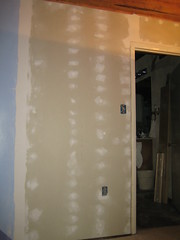
There’s a long way from the bare drywall to the furnished home we hope to end up with. And even after we slap on the paint and get our boxes through the door, it’ll still take a lot of work—and maybe some more paint, some help from friends and professionals, a lot of reading catalogs and home magazines. . . .

But finally, after all that, we have a home we can be proud of—and one that we didn’t have to completely rebuild six times. (Okay, I’ve probably beaten that analogy to death.)

What do you think? Do you like to consider yourself a “story architect? How much detail (or freedom) do you need in your “floor plan” to make a house work?

Next week, we’ll start looking at methods of plotting—and don’t forget, I’m looking for volunteers to talk about how they plot! And tomorrow—free goodies!

Photo credit: floor plan—Richard Crowley; dry wall—Pattie; room and photo—Christopher Barson

Making it up as she went along–the Winchester Mystery Story

Larry Brooks, “the story fixer,” had a recent post that really got me thinking about this—Story Structure vs. Story Architecture: “Dude… what’s the diff?”

All stories, says Brooks, have structure. And, to employ my own analogy, so do all buildings. But not all buildings are created equal:

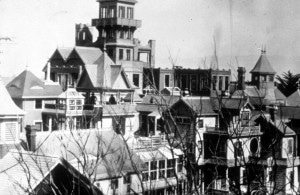
Winchester Mystery House Scary Exterior Tower

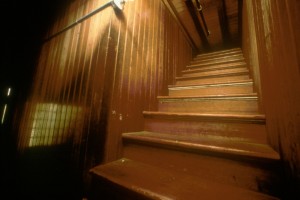
Winchester Mystery House Stairs to the ceiling

winchester mystery house

You might recognize this place, or the legend behind it. The owner believed that her house must be under construction always, or she would die. But they couldn’t use a master building plan.

Considering that, the Winchester Mystery House is pretty well-built. Yeah, it has stairs that lead to nowhere and doors that open out from the second floor (no stairs on that one—maybe move those first stairs over there?). It’s fun—it’s a blast to explore, and I bet Sarah Winchester had an awesome time throwing in every element she could think of.

It has a decent foundation—instead of leveling it, the 1906 San Francisco earthquake only knocked off the top three stories. After the quake it stood four stories. The remaining structure is a rambling, 160-room, 4.5-acre mansion. It required more than 20,000 gallons of paint—and it constantly needed painting.

I think we’ve all gotten to the end of a story, looked back and seen our own Winchester Mystery Structure. The Winchester Mystery House has structure. In some sense, it has architecture—but not really. There is no plan, and the closest thing they had to a designer (architect) was a crazy woman.

And “rambling” is right. Dead ends, doors and promises that go nowhere, accidental MacGuffins. . . . After round 28,657 of revisions, I got tired of writing stories that looked like they were designed by a crazy woman.

What do you think? Have you ever written a “Winchester Mystery Story”?

Photo credits: exterior shot and stairs to nowhere courtesy of the Winchester Mystery House; rooves—the_photographer; windows to windows—Emily Hoyer

An “organic” story

This entry is part 2 of 24 in the series The plot thickens (Mwahahaha)

Yesterday, I shared my experience with my “conversion” to plotting. And it turns out I wasn’t alone. As Katie pointed out, it seems like most of us had the same problem:

starting out as a pantster, realizing that writing-by-the-seat-of-our-pants exposes our weak areas, and realizing that plotting is necessary to some degree.

flying fingersI think that the mystique of the organic story, one that is so perfect and beautiful that it just wrote itself, is one of the big things that convinced a lot of us (or all of us) to become pantsers (and maybe even writers). There’s this romantic notion that “real” writers, “great” writers sit down and pound out a fabulous story, with minimal rewriting and never, no never, no never any planning in advance.

And then we try it—and somehow it doesn’t seem to work. We learn more about plotting, and give that a try—and lo and behold, we have story arcs. We have a non-sagging middle. We have a character changing and growing through the climax and resolution.

Granted, these don’t always automatically fall in line with plotting and planning—but often when we start a story with these things in mind, we are more mindful of them not only in the planning but in the writing, and look for opportunities to help our characters grow and change, to continually challenge them. (Or, as I like to put it, to put the screws to them.)

So, our mission (should you choose to accept it!) for this series is to look at the whys (for the unconvinced) and the hows of plotting. I’d also love to get some guest posts on how individuals put plotting to work for them—so if you’d like to volunteer to give a brief overview of your plotting process, let me know! (And stay tuned for a new free guide on Friday!)

What do you think? How can learning about plotting help you? Do you think you’ll ever go back to pantsing?

Flying fingers by The Hamster Factor

The plot thickens!

This entry is part 1 of 24 in the series The plot thickens (Mwahahaha)

As Andrew guessed last week, our next series is on plotting! (I’m mentally referring to this series as “Mwahahaha.” Three ha’s, if you please.)

plotthickensLast week, we discussed plotting briefly—but now let’s get into it. What do you want to learn about plotting? Are you a plotter or a pantser? Have you changed “sides”? (I have.) If so, why?

I used to be a pantser—some romantic notions about a story springing fully formed from my head like Athena from the mind of Zeus, and fears about outlining killing my muse. I would start off with an interesting beginning, a twist or two in mind, and the end goal. I would make up the middle parts as I went along.

And then I got stuck.

For like a month. (That’s a very long time for me, when I’m in the middle of the draft and supposedly letting those unstifled ideas flow.)

I finally got unstuck, but what I made up as I went along ultimately didn’t work. It all had to be rewritten, and should I hope to publish that MS one day, I’m probably going to have to toss most of it and do a whole new plot (with one or two of the same twists and turns, because they made those characters who they were, but other than that, starting from scratch with the characters/situation).

My next project was something I did with one of my best friends. We came up with an idea to write parallel novels with four main characters (a hero and heroine for each of us, with her heroine and my hero as siblings).

Oh, and also it was going to be a murder mystery (on my side; less so on hers, since they couldn’t all be investigating). We had to know who did it, when, and why—what events led up to it, what other characters were involved.

tapping pencilAnd since the investigation was part of my story line, I had to plot.

To my surprise, instead of killing my muse, plotting fueled it. I got to know the murderer (with a 1st person character freewrite) and his motivations. I searched for the worst possible thing that could happen—and the next, and the next, and the next—and made sure even the good things that happened were timed to my characters’ disadvantage.

I came to love turning the screws.

To me, plotting is your first chance to know your story. You may be like I was, and have an ending and one or two twists in mind, and take off to discover the rest. And there’s joy in discovering the story, finding the characters and their twists and turns.

But when I’m plotting, I get to experience that all at once. I get to discover—engineer—the twists and turns in a matter of hours, to hold the whole story in my mind (which I just can’t do with 100,000 words). As I mentioned last week, when I know what’s coming, I can plant clues, turn those screws to make the coming disasters even worse, or foreshadow. Naturally, I’ll have to go back and tweak all those things, but some of my favorite nuances have come from knowing where I’m going and finding a happy coincidence in the present scene.

I’m hooked.

What about you? To reiterate the original questions: What do you want to learn about plotting? Are you a plotter or a pantser? Have you changed “sides”? If so, why?

Tapping pencil by Tom St. George

If actors were like writers

This is how they’d get agents:

Dearest Prospective Agent,

Forsooth! I write this epistle to thy milky hand (thou art a maid, aye?), that I might win it and thee thereby to be mine agent. I see that thou doth represent mine colleague, Laurence Olivier, and thou must know that I am indeed a most convincing method actor. Thou mightest be able to tell from this letter that my true skill rests in Shakespearean tragedy.

I would be overjoyed to discuss my career. I call anon!

Sincerely,
Archer Feathersboroughbottom

(In case you’re wondering, actors get agents by a.) agents seeing their work and contacting them, b.) referral from other actors to their agents, or c.) sending a photo and résumé to an agent, which does seem a bit more appropriate than a query letter.)

What do you think? How would you query an acting agent?

Photo by Hashim Talbot

37 ways to keep readers’ pulses racing—and keep them reading

This entry is part 1 of 26 in the series Tension, suspense and surprise

I’m brushing up today on creating tension in a scene. There are lots of “tricks” and techniques to get the “tension in every page” Donald Maass recommends. While I don’t really go in for resorting to tricks to create suspense, little techniques can really establish, increase or build the tension within a scene.

Looking for info on rewards per page for your novel? Check out this post on giving readers what they want!

The list:

  1. Give a character a goal in each scene
  2. Setbacks to a character’s goal in a scene
  3. Uncertainty—often from a lack of information
  4. Worry—plenty of bad information
  5. Doubt, especially in one’s self (the character, not the writer πŸ˜‰ )
  6. Raise the stakes—put more people or a bigger, more valuable objective in danger
  7. bite nails

  8. Increase the odds against the character
  9. Make the characters care more—greater emotional stakes
  10. Make things more challenging
  11. Surprise character or event to change things up
  12. Nonhuman obstacles—setting or weather interfere
  13. Using the POV of a character that doesn’t know something vital (something we’ve established in another POV)
  14. End the scene with a foreboding foreshadowing
  15. Play on a character’s inner anxieties—push them to the limit (and beyond)
  16. Let the characters blow up—what are the consequences?
  17. “Minidisaster”—a preview of what could happen in the big disaster, by showing a small version of their impending doom.
  18. A close call
  19. A character purposefully withholding info from another
  20. Jump cutting to another scene/storyline immediately after a disaster
  21. Make characters’ goals look impossible. Or just make them impossible.
  22. Stating a chilling fact.
  23. Danger—dangerous, skillful work.
  24. Deadlines approaching
  25. Foreshadowing a coming confrontation
  26. grip knuckles

  27. An unfortunate meeting
  28. Trapped in a closed environment (perhaps a crucible?)
  29. Fears coming true
  30. Set up any of these situations and prolong them, rather than relieving the tension
  31. Remove characters’ supports
  32. Disable characters’ strengths
  33. Undermine characters’ belief systems (not necessarily in a religious sense, but in a “I’m fighting for the greater good—holy crap, what do you mean the victim’s a bad guy?” kind of way)
  34. Move up the deadline
  35. Avoid low-tension scenes (sequels, really):
    • Thinking (esp while driving between one scene with live action and another)
    • Decompressing or cleaning up
    • Coffee breaks
    • “Aftermath” scenes
    • Sometimes, even love scenes—a sex scene releases all the sexual tension you’ve established, so then you have to reestablish that tension with something to keep them apart. Though this can be done well, often, this is where we get the contrived or entirely external conflicts that just aren’t that compelling.
  36. Leave out the parts people skip πŸ˜‰ —distill scenes to their essential parts
  37. Cut small talk (unless you’ve worked hard to establish that the small talk is covering something else, something with a lot of tension, or you’ve got a lot of subtexting)
  38. Make one character’s scene goal conflict with another’s scene goal
  39. Make us root for the other guy—make the antagonist a sympathetic character, so we want both sides to win.

Sources: Revision And Self-Editing by James Scott Bell, Stein On Writing by Sol Stein, Writing the Breakout Novel by Donald Maass, and me, of course.

What do you think? What do you do to create or increase tension in a scene? How can you implement these ideas in your work?

Photo credits: nail biter—Cavale Doom; knuckled grip—Alex Schneider

How do you write?

I have to admit it: I’m one of those writers who doesn’t really do much of anything until I absolutely fall in love with an idea—anything from a character to a scene to a setting. My ideas come from dreams, friends, books, movies, TV, etc. But until an idea really grabs me, I can’t sustain my interest enough to spend three or four months on drafting.

light fire matchesBut man, when that idea strikes, it’s hard to make myself do the normal day-to-day, keeping-the-house-clean, being-a-mom stuff. All I want to do is write, and yet no matter how fast I write (my record is 5000 words in a day), it’s not fast enough. The rest of the book stretches out in front of me, scenes and lines and snippets that threaten to slip away before I can get there. So I race on.

An idea struck three weeks ago. So far, I’ve gotten down almost 23,000 words. (Woot! Check out my progress bar in the sidebar.) I’m excited to be drafting again (first time since April), and if I finish the draft by October 21, I’ll have drafted three books in a year. That’s pretty cool.

It’s interesting how different each book is, you know? Not just plot-wise or character-wise (although these three books have the same hero/heroine), but process-wise.

This time around, I’ve accepted that what I like to get in there are people, action, dialogue and plot twists. Cool. On my last MS, I tried to get everything in there on the first draft—sensory details, settings, character descriptions, etc. etc. This time, I’m embracing my favorite parts—I mean, I’ll put in the other stuff as needed, but if a scene is all dialogue/action, and it takes place in a vacuum, I’m not going to cry about it in this draft.

inspireFor me, that’s stuff I can add later, in each layer of editing. In fact, I’m taking this week off drafting to go back to the first MS I wrote during this year to add in more of those descriptions and sensory information, since the second half of the book is rather bereft of those (silly me, thinking all the character and setting descriptions were established in the first half, and we wouldn’t need anymore after that!).

How about you? What inspires you? Do you try to get everything in one draft—and if not, what do you leave out to add in later?

This week is probably going to be a bit of a catch-all week as I try to get things done between editing bouts and housecleaning—and, of course, working on the PDF from our website series. But next week, we’ll start another new and awesome series. I think πŸ˜‰ .

Photo credits: matches—Kicki; inspire—Mark Brannan

The challenge of a pseudonym, LaBeletteRouge.blogspot.com

Today we have our final website review for La Belette Rouge: oh, the luxuries of going last. Have you been reading and making adjustments all along? Cheater πŸ˜‰ .

(Remember, we’ll be doing more website reviews in a few months, so subscribe so you don’t miss the call for volunteers!)

belette1

Kathleen’s comments

Dear ‘Belette Rouge,’

I visited your site and I was . . . intrigued. It seems that you have a pretty wide circle of friends online, and that’s a good thing! The number of comments your posts bring shows that you’re doing something right. πŸ™‚

But to be quite honest, I’m not sure what to review! I see from the series down on the left that you have blogged on writing . . . but that doesn’t seem to be the focus at present. Without reading the whole blog, I don’t know what you write, to know if it’s something I’m interested in. I’m not sure what the focus of the blog is, to know if it’s something I might like to subscribe to. I don’t know what “Belette” means, so that doesn’t give me any hints.

question_3I’ll ask you the same thing I asked a few other blog owners . . . what is the purpose of your site? What is your goal? If yours is community (which you seem to be doing excellent at fostering), then I think your community would attract new participants more easily if your site clearly states what your community revolves around.

Give the site a clear blog description, and put something at the top of your sidebar, or above the posts that explains it a little more. [Also, a tag line displayed as part of the header can be a great help for quickly letting visitors know what your blog’s all about—Jordan.] You might find new readership builds much faster!

I’ll be offline for most of next week, but if you’ve got a specific question, go ahead and ask it in the comments and I’ll reply when I’m back online.

Happy blogging!

–Kathleen MacIver / KatieDid Design

Jordan’s comments

Pages

Your blog is another example of a “lifestyle” blog, where you blog about your daily experiences from the mundane to the therapeutic. You have a great voice and wonderful humor that comes through in every post.

However, while you have a series on life as a writer, you don’t highlight any WIPs or works prominently on your blog.

volunteerThere may be a good reason for this. If you’re purposefully blogging under a pseudonym, and you want it keep it that way, you may want to keep potential publication info away from your site so you don’t get your real name associated with your site. (Then again, maybe you should be writing under a pseudonym, too.)

But if you don’t have that aversion, you might consider featuring your works more prominently.

I might also suggest a menu bar—a single line of text underneath the header that links to the permanent features of your site. This is where you can put links to your About page, a page about your WIPs and writing credits, and possibly pages on the various areas of your site—writing, infertility, Francophilia, etc.

Sidebars

The top two elements in your sidebar are encouraging visitors to subscribe—nicely done. I might add a little explanation (or a link to an explanatory post) in the first Subscribe widget (if possible), so people know what it means to subscribe—something you do well for the email subscription link.

Your contact information is fairly prominent on each page, as the third element in the sidebar. However, because your header image is so long, that contact information is below the fold. I’m torn over whether that’s enough. But it’s good that you offer several different ways to connect with you.

glassy eyedAlso, your sidebar is quite long. I really like that you’ve been highly selective about what badges and honors to display. However, there are still a lot of links there. When visitors come across a long list of links, their eyes are likely to gloss over—they can’t focus on any single link, so they don’t bother looking at any of them. (A lot of links on a single page may also dilute the value you’re passing along to the sites you link to, in search engines’ eyes.)

If you want to make the links in your sidebar stand out more, you might consider having fewer of them. Don’t worry, I’m not saying you should just ditch links to your favorite blogs—but over 200 links on the main page is kind of a lot to handle. Instead, you could consider a single post, linked in your side bar or menu bar, for all your favorite links/blog roll. You can still use the same headings and divisions on the page, too.

Your own search engine presence, however, is fantastic. Your blog is #1 for [belette rouge] on Yahoo, Google and Bing (and also #2 on Yahoo and Google and #3 on Bing). The rest of the top ten results are all about you—your Facebook profile, your blog on various blog sites, friends’ mentions of your blog.

And obviously, with that many followers and that kind of discussion on each post, you have a fantastic community on your blog.

What do you think? Would you rather have a popular community on a lifestyle blog under a pseudonym where you wouldn’t want to promote your writing, or an author website with your real (or publishing) name?

Photo credits: question—Svilen Mushkatov; no pictures, please—StillSearc; glassy eye—Michelle Mangum