How to set up an aspiring author website

This entry is part 3 of 5 in the series Aspiring author websites

If you’ve been following our website review series, you’ve learned some great things to do (and not to do) when setting up your website. Maybe you’re ready for a “real” website, but not sure how to get it. It’s okay; I’ve worked with websites and Internet marketing for the better part of my life and I still didn’t know exactly how to set up a website until I did my own. And it’s easy.

There are three basic things you need for a functioning website:

  1. a domain (you get this from a domain registrar, like GoDaddy)
  2. a host to store your website’s pages and files (from a hosting company)
  3. (technically, you don’t need this, but unless you’re going to be doing all your coding by hand, you’ll want it) software to work the back end—and hopefully generate the HTML code (usually provided by the hosting company, too)

blogger logoSometimes you can get these things together. Blogger, for example, will give you everything—your domain is whatever.blogspot.com, Blogger stores your pages and files, and Blogger software generates your HTML code and provides the software that lets you maintain your site.

In fact, you can make Blogger into your “real” website, which can be especially useful if you’re going to be the one maintaining it. You can also use Blogger Custom Domain to put your Blogger blog at YourDomain.com, and Camy Tang has a useful guide on how to make a a basic free blog more like a website. UPDATE: Blogger has now added a feature to make official “pages” instead of making posts look and act like static pages of your blog. It’s even more flexible and professional-looking now!

Getting more advanced

If you feel like you’re ready for a more “real” website, but still apprehensive about setting one up, here’s my advice: use WordPress. This is especially great if you’re already comfortable with blogging software, because you get the ease of blogging software and the features of a “real” website.

wplogoYou can use WordPress.com (and you can get a WordPress.com blog to show up at YourDomain.com, too, but it’s not free like it is on Blogger)—or you can use WordPress.org. It’s the same software, but with WordPress.org you can customize your blog however you want.

However, for WordPress.org, you also have to get hosting—space on a server to store your website’s files for others to access them. I’ve been with BlueHost for over two years, and they’ve done really well for me. I chose them because they were inexpensive ($7/month), and one of WordPress’s recommended hosts.

WordPress has some advantages over Blogger that make it more like a “real” website. Camy Tang’s guide above will help you create static pages like an about page or a contact page on Blogger. That’s great—but they’re still going to look and act like posts on your blog.

With WordPress, however, you can keep blog posts and pages separate. Don’t want a blog? That’s okay—you can do that with WordPress, too, and just use the page features to easily create a static website instead. Check out the menu bar at the top of my site. See how it says “About” and “Projects,” etc.? Those link to WordPress pages—timeless, static webpages that aren’t posts on the blog.

Also neat: WordPress made that menu bar all by itself. I didn’t have to do a thing. It updates the menu bar whenever I update a page. WordPress is highly customizable, in both the site design and software—and for free.

If you want to create a WordPress website on BlueHost, sign up for BlueHost using my affiliate link and I’ll send you a free PDF guide to setting up WordPress with BlueHost*—with info on installation, set up, importing blogs, add-ons and more! (If you’re planning to import another blog, also check out my search-engine friendly guide to migrating from Blogger to WordPress to make your switch safe and easy.)

What do you think? Are you ready for a real website?

* To get the guide, be sure to email me at guide at jordanmccollum.com once you’ve completed the sign up.

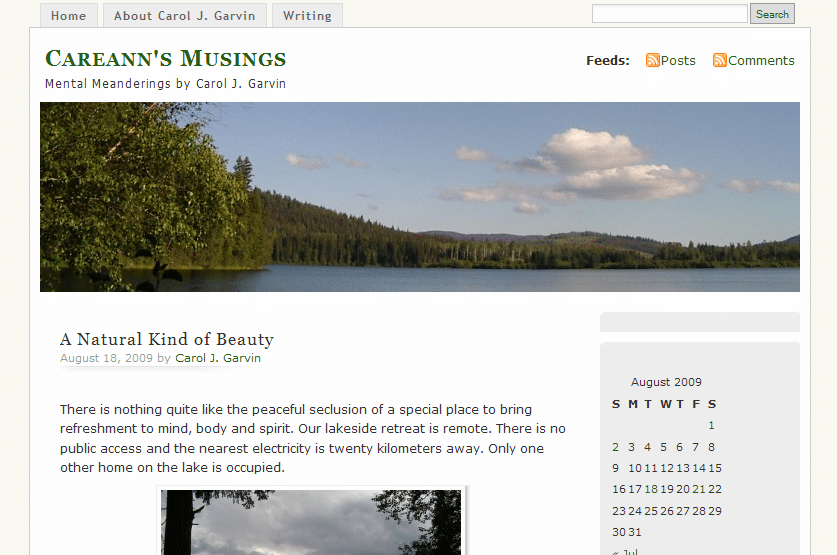
Your blog’s niche: careann.wordpress.com

Another website review for you today! Carol/Careann of Careann.wordpress.com is another one of those bloggers I feel like I’ve seen just everywhere. We’ll look at how she can find and apply a niche to help grow her blog.

carol1

Kathleen’s comments

Hello Careann!

Yours is another blog that I’m honestly not sure what to talk about! Your title and picture accurately represent the content, and it’s laid out in an easy-to-follow and eye-pleasing way!

I’m going to ask you the same question I’ve asked a few others. What is the goal of your blog? If it’s self-expression and telling people who you are, then I really don’t see anything to change! I don’t think it’s to promote the articles you’ve written, as they’re already published in magazines, and you won’t get paid more if they go find an old issue. (Or will you?)

Are you wanting to interest people in your unpublished novels? I don’t think so, since you don’t mention them that often . . . which is fine. Some of us like to do that, while others wait to be published. Neither approach is wrong. Once you DO have novels to promote, you’ll want to change the whole focus of your blog and site . . . but that’s not right now.

The final possibility is that you’re like last Friday’s blogger . . . you’re just looking for community online, and your blog is a part of that. If that’s the case, then I’ll copy something I shared with her in the comments.

In order for something to succeed in today’s world—where the whole world is essentially connected and available to everyone—it has to fit a niche . . . a smaller target or focus. We all can’t “afford” to be interested in everything and involved in everything on the entire Internet, so we “weed out” what is slightly less important. We look for that thing that interests us 101%.

Your website/blog will be more likely to succeed if you find SOMETHING to center it around . . . something a little more specific than just “writing.” If you don’t want to center it around a genre, then you can center it around your location and try to find writers near you, or who are interested in your location. [This might be what you want to do, Careann. All you’d have to do is highlight your location.] Or you could target writers in your age group. Or you could center it around writers-who-live-in-the-country. You could even pick yellow paintsomething quirky, like writers who love yellow or writers who love to go barefoot. Of course you’d welcome writers (and readers) who love pink a little more than yellow, or writers who really don’t go barefoot all that often . . . but just the fact that it’s got this “grabby” idea will make your visitors more interested, and also make your blog stick in their minds a little more.

Have some fun with ideas!

—Kathleen MacIver, KatieDid Design

Jordan’s comments

Whoa! My next WIP was going to be set in the Fraser Valley Regional District (in a fictional city between Abbotsford and Chilliwack—I was going to call it Lackaway, but I wasn’t sure if that’d sound too rhymey to be believable as a neighbor to Chilliwack. Um . . . anyway. . . .). Awesome—if I ever go back to it, I’ll know who to call!

Pages

Your about page is good&madsh;personable, friendly and informative. It has links to connect with you and your email address. But if I didn’t already know it was there, I might not think to look on the About page before giving up (and, of course, I might). This is why it’s also good to have a dedicated contact page—it doesn’t have to be long or even say anything interesting. You can use a form or list your email address (but do keep it on the about page, too).

I like that your writing page has your writing credits with links to the articles where possible. That’s great! But, like Kathleen said, I’d like to see more about your fiction WIPs (if you’re comfortable with that). It doesn’t have to be an excerpt; even a pitch paragraph or log line description would be good.

I also like that you highlight your Flickr stream on your blog. You link to your Facebook profile on your About page as well; you could add a badge to your sidebar if you’re comfortable with that.

Search engine presence

You’ve got some competition for your name (without your middle initial)—apparently another Carol Garvin is a painter. Yahoo has your blog at #4 for [Carol Garvin], and Google has your about page as #10. Bing . . . well, let’s just move on.

With your middle initial, your blog is #1 on Yahoo and Google (well, #1 and #2 on Google), and #2 and #3 on Bing. Your IMDb page (that’s right, folks, she’s in the Internet Movie Database) outranks your site on Bing.

For [Careann], Yahoo has your blog at #1 and #2, Google has your Flickr stream at #1 and your blog at #2 and I’m about ready to slap Bing in the face.

As always, the standard advice to improve your rankings is to get more links. In addition to the usual sources (guest posts, etc.), you might ask the magazines with your articles online to include a link back to your blog, either in the byline or if they have a short author bio, using your name as the link anchor text.

missing puzzle pieceFinally, I just want to reiterate what Kathleen said about using a niche approach to blogging. Working to appeal to a specific, if narrow, audience can help to grow your blog more than trying to appeal to everyone. This is just like fiction—we don’t expect that everyone will love everything we write (well, okay, we do, but we don’t reasonably expect that 😉 ). We know that we have to write to our audience—our niche, our genre.

Also, check out some recent posts on my other blog for help on finding your blog niche and expressing your blog niche.

What do you think? Have you focused on a specific audience with your blog? How did you find your niche?

Photo credits: yellow paint—Tom; puzzle piece (get it—a niche?)— Andronicus Riyono

Integrating social media & sidebars: WordVessel.blogspot.com

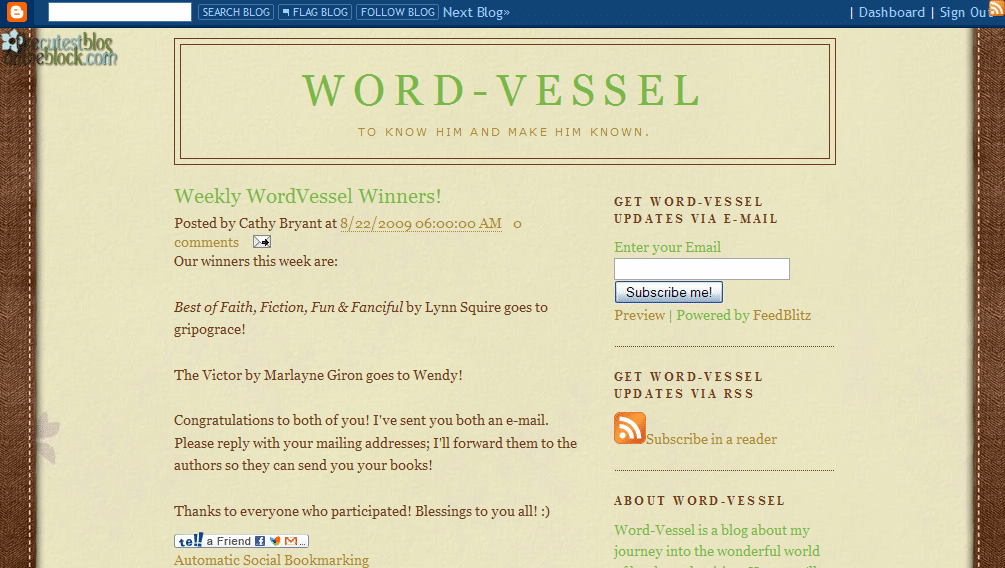
Today we have a great example of integrating social media from Cathy Bryant’s blog, WordVessel.blogspot.com. We’re also going to take a look at the ordering of her sidebar.

Jordan’s comments

Pages

I see you’ve contributed to a published book—congratulations! You could feature the purchase link a little higher in your sidebar, however—anywhere from the top to after the “About Me” section, depending on how prominent you want it to be.

You could also feature your current works a bit more, to let us see what genre you’re working in. You don’t have to put an excerpt up if you’re not comfortable with that, but some indication of what you’re working on, possibly in your about page or profile, can be helpful to help other authors connect with you, as well as other publishing professionals.

Your Blogger profile is good, and the about paragraph in your side bar is good. They’re personable, explain the purpose of your blog and who you are, and inject your personality into your blog. You could also create a post on your blog to give that information on your blog itself. (And then link to that page in the side bar or in a menu bar.)

You have your email on your Blogger profile, but you could have that on your website, too, either on an about page or a contact page. Again, these could be linked in a side bar or menu bar.

cathy6smallSpeaking of the side bar, you’ll note at right that I have the first thirteen screens of your blog here (with orange arrows highlighting the advice from me and Kathleen), and neither the content nor the sidebar is anywhere near the end. But it’s not until the eleventh page down that I found the purchase link for your book, and the ninth through twelfth that gave me the social media links. Even below that (not shown) is your search widget. With it that low, your visitors are going to need a search widget to find your search widget! 😉

Think about what you have in your sidebar—and what, of that, is most useful to your visitors. It’s fine to have awards and accomplishments there—it’s a great place to display your “trophies.” But when you order the stuff in your sidebar, consider what will help your visitors find what they’re here for? What will keep them coming back (ie subscription links)? What do you want them to notice most (ie published works)?

Search engine presence

You are all over the search engines—woot! You have social profiles from Facebook, Amazon, ShoutLife, Shelfari, Gather, GoodReads, NaNo and more. It’s good that you’re networking and using all these social sites. Your blog is ranked #5 on Google for [Cathy Bryant], but not in the top 10 on Bing or Yahoo.

Also good news: your blog ranks #1 on Google, Yahoo and Bing (yes, Bing!) for [word vessel]. Yahoo and Google also have additional posts from your blog on the first page of results. This is great—but it’s important to remember that if people are looking for you professionally, they’re more likely to search for your name than your blog name.

You can try to get links back to your blog with your name, and you can try to add links (that search engines recognize—Facebook, for one, doesn’t use that kind of link) to your blog with the anchor text “Cathy Bryant’s blog, Word-Vessel.” If your social network profiles have blogs of their own, you can sometimes have them import your blog or excerpts from your blog posts. If you have links in your posts back to other posts on your blog, that can help to increase your blog’s overall authority. Higher authority = higher rankings.

There are two caveats with that practice however. One: search engines penalize content that’s just copied off another web page, pushing it down in the rankings—so if your social network profiles are already outranking your blog, you might end up with your blog posts on your social networks outranking your blog posts on your real blog (which is why you might want to do excerpts only). Two: be careful about the social networks’ terms of service. I stopped importing my blogs to Facebook because I didn’t like the ToS, which implied at the time that they could keep or even claim your content.

Social media

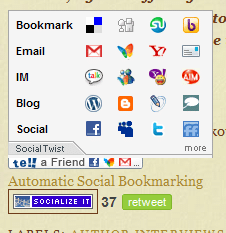
Mouse over—pops up lots of options for sharing

No mouse: small and unobtrusive

You’ve done an excellent job of integrating social media into your blog! At the bottom of each post, you have various options for sharing your posts through social media from Twitter (though it looks like the TweetMeme counts are off—all your posts link to the counter for a single specific post) to Facebook to email to blogging about it ourselves, with the above widget that appears easy to use. See how it doesn’t take up much room, but expands when you move your mouse over it to offer lots of options?

Also, you have links to your profiles on a host of social media sites in the sidebar, which allows users to share your content and connect with you. I might recommend moving this up a little bit, so it’s above the long archive list—a little more prominent, and more likely to be noticed.

It’s also good that you display your subscription options prominently above the fold, but you might be able to add a little bit here to explain more about what these are.

Kathleen’s comments

Cathy,

Hello! I love the look of your site. It’s cute and has character, which is always a good thing! Your “About Word-Vessel” paragraph is good, as well. It’s a short summary that explains the blog and welcomes people in a natural way, rather than in a here’s-a-list-of-things-I-want-you-to-check-out way.

However . . . those reasons for your blog really shouldn’t be necessary. They don’t hurt, because lots of people look for them. But you want them to look for that paragraph because they want to, not because they can’t figure out what your blog is about without it.

When I arrived at your blog, I noticed the background, and I noticed the nice clean look. I noticed that your sign-up widgets are in an excellent spot . . . but I didn’t know what content I would be signing up for!

I read your blog description, which told me that you are a fellow Christian, but it made me think that this is a ministry blog. But then I read the first paragraph of your current post, and it was about your writing. That’s why I went looking for the “About Word-Vessel” paragraph.

I’m thinking that your blog name and description is more a description of you, rather than of your blog. I’m wondering if you could find a variation of it that reflects the focus on writing that the blog actually has. I suppose “Word” could black_notebook_with_pencilreflect writing, but to me (and probably other Christians who would be interested in your blog), Word meant the Bible, which doesn’t have anything to do with your writing. You want both . . . both the Christianity that your blog definitely reflects, and the fact that YOU write fiction (or non-fiction, whichever). Another option would be to find/make/have made a header image that uses images to portray some of this. ie: a cross would tell people this is a Christian blog, a pen and paper would portray writing, a stack of books would portray books. You’d just want to make sure the image is as well-done and tasteful as your background image is. Otherwise you’re better off sticking with text.

Finally, for your blog (I’m not going to suggest this for everyone), I think it might help to move that “About Word-Vessel” paragraph up above the posts. It’s small, so it won’t shove your posts much farther down the page, but that would be a good place for that introduction. This way, when visitors arrive, they’ll see a nice clear blog title and description that instantly tells them that this is a Christian blog about books and writing. Those of us that are interested in those things will then be given a very brief paragraph with just a tad more detail. After that . . . the content! Your posts flow smoothly and are written well, so I think you’ll then be set to capture subscriptions from anyone who is interested!

God bless!

–Kathleen MacIver / KatieDid Design

What do you think? What kind of things are you looking for in a sidebar, as a visitor and as a blogger?

Photo credits: typofi

Spires of Stone by Annette Lyon – Review

I’m catching up on my Summer Reading Thing reviews today, and we’ll be back on the website reviews soon!

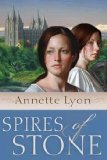
Spires of Stone is a retelling of Much Ado about Nothing—a story of false accusations, slander, verbal sparring, making amends and forgiveness.

I was most surprised by how much I remembered of Much Ado—Annette used not only the plot lines (though she did change them slightly and eliminated a few characters), but also the actual lines from the play. (I’ve seen the play live once, six years ago I think, and the Kenneth Brannagh movie maybe three times in my life—had no idea I’d remember all that! Oh, and I think I might’ve seen the opera Beatrice and Benedick. . . . Maybe it’s not so surprising after all.)

My favorite parts were the scenes where Claude (Claudio) and Phillip (Don Pedro) are conspiring to trick Ben (Benedick) into admitting his feelings for Bethany (Beatrice) (and Hannah (Hero) and Marie (Margaret/Ursula, here) conspiring to do the same favor for Bethany). I especially loved how Benedick’s and Beatrice’s lines from those scenes translated into their internal monologue.

In all, I thought this was a good adaptation of a classic. Of course, Annette changed some of the plot for her characters—notably, they don’t pretend Hannah is dead just to make Claude pay. I was thinking maybe this wouldn’t work in fiction anyway—after all, in a play, there’s a lot less suspension of disbelief. You don’t have to stop and think, “Would someone really believe a falsely-accused woman could die of shame?” because it’s happening right before your eyes—and not even on a TV or movie screen, but with real people (even though you know it’s not real, there’s some evidence that our brains aren’t quite smart enough to differentiate between simulated reality and reality).

What do you think? Does fiction have to be more “believable” than drama, especially live-acted drama?

Having Hope by Terri Ferran – Review

I’m catching up on my Summer Reading Thing reviews today, and we’ll be back on the website reviews soon!

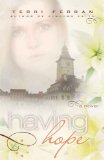
I won this book in a drawing at my bookstore in March, and now I’ve finally gotten around to reading it. In Having Hope by Terri Ferran, Kit Matthews has the guy of her dreams—but she wants to do something to contribute to the world. When she finds out about an opportunity to work with orphans in Romania, Kit feels like she should go, even though everything seems to be conspiring against her going. But once she’s in Romania, things get worse. Her parents decide to get a divorce, she’s far from her home and boyfriend, and a handsome Romanian starts pursuing her.

I loved the section in Romania although overall, the picture of the Romanian people didn’t always come off as flattering. But “experiencing” a new culture was fun, especially since I’ve known a few Romanians. I laughed out loud at some of their encounters in this book, and their experiences kept me turning pages.

However, I didn’t find the end of the book satisfying. Ultimately, I think that I didn’t see the character change enough. Yeah, she’d been through these neat experiences that could have really changed her life. I wasn’t expecting her to do a 180, but it just seemed like the middle section of the book had no impact on who the character was at the end.

What do you think? How much does a character have to change to make the end of the book satisfying?

Setting goals: TriciaJOBrien.blogspot.com

Moving right along, we have another blog review today for TriciaJOBrien.blogspot.com. I’m beginning to run out of cute things to say here, so let’s jump right in, shall we?

Kathleen’s comments

Tricia,

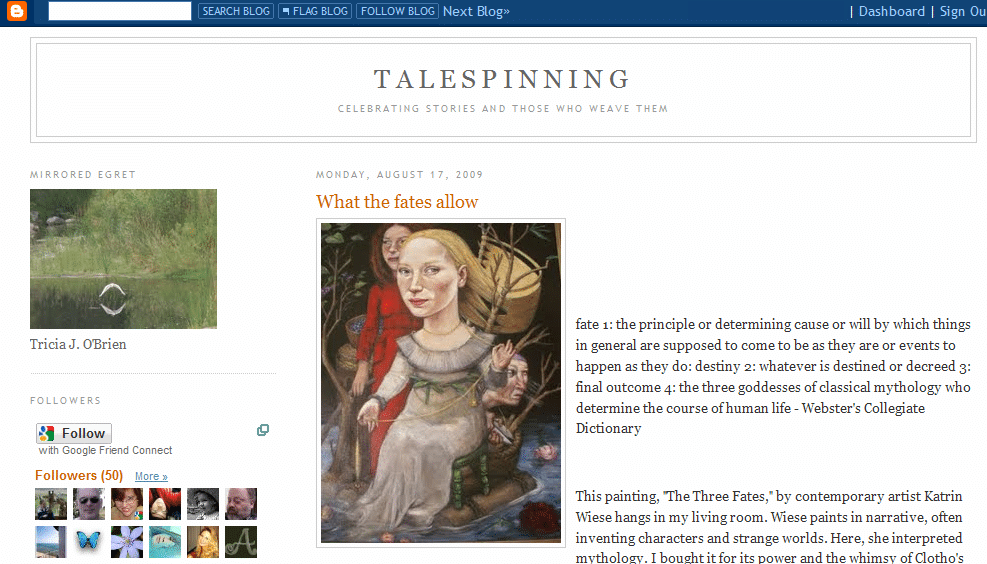
Your blog doesn’t have bells and whistles and graphics and so forth, so I was immediately led to start reading your posts . . . and I saw instantly that you’re a very natural writer. Your words seem to flow from your mind through your fingers. And if you struggle with grammar or syntax, you hide it VERY well! (I really, really doubt it. Your words flow too effortlessly, your voice is too clear, and people don’t spend months editing blog posts!)

I never really did find what the goal of your blog was, though. Is it primarily for you, as a method of self-expression? If so, then who cares what it looks like!

The fact that you asked for this review, however, makes me think that you ARE hoping this blog achieves something. It doesn’t appear that you’re trying to promote your own writing, since a skim down through the posts showed me nothing along those lines. Are you trying to build a small community? Just meet people online? Right now this blog is a pretty clear reflection of you, as a person, and your love of words. It’s not a reflection of your stories or books or poems, or of a particular genre. Do you want it to be?

I’m not really sure what to suggest, since I don’t know what that goal is. But think about it. This is where every website should start . . . with a careful assessment of what the goal of the website (or blog) is, what you hope it will achieve, and who you hope to reach with it. Everything else needs to follow that.

I’ll try to watch the comments over the weekend (which is sometimes difficult). Let me know what you’d like this website to accomplish, and I’ll see if I have some ideas that might help you achieve that.

–Kathleen MacIver / KatieDid Design.com

Jordan’s comments

If I were guessing (oh, wait, I am!), I’d put your blog in the get ready phase—you’re networking with other writers, and discussing writing with them. Your blog is a good way to make sure that other writers can connect with you, and to start building a community.

Having the Followers widget high on the sidebar encourages your visitors to become followers—the prominent placement is visible on every page load, and it also promises 24 lucky readers their headshots on your front page. You can also directly mention the following option, explain it to your readers, or even run a contest for followers if that’s your goal. (More on Blog Followers). You could also use a subscribe widget in the sidebar to encourage your visitors to subscribe via RSS or email.

I can see from your site and its content that you like to write. But I can’t tell what you’re writing—whether you’re a hobbyist or trying to make a career of it (nothing is wrong with either of those, of course, but I just don’t know). I can’t tell what genre(s) you’re working in.

After a little digging, I found your post from Teaser Tuesday earlier this month, with the beginning of your WIP. You could feature that post more prominently—with a menu bar or a link in the sidebar—to help visitors know that you’re an active writer, working toward publication, in YA fantasy.

You mention that you were once a newspaper writer. Would you care to go into any more detail, maybe link to some columns? You could also write an “About me” post, and link to it in a menu bar or sidebar, so we can learn more about you right away. Even in the get ready phase, it’s important to have “You” in an accessible format on your site—people like to network with people. (On that note, you have your email on your Blogger profile, but a lot of people probably won’t think to check there. I know I harp on this, but seriously—contact page!)

Search engine presence

You’ve got some professional competition for [Tricia O’Brien]—a real estate agent who’s working for that top slot.

However, for [Tricia J O’Brien], your blog is in the top two spots and your Blogger profile is #3. Woot! Rounding out the top ten are two more references to you on JacketFlap.com, and some kind of random stuff.

Yahoo has your blog as #5 for [Tricia J O’Brien]. It’s outranked by posts mentioning you at Literary Lab, Corey Schwartz’s blog and JacketFlap.com.

Bing . . . sigh. Why, Bing, why? We’re right here! Look us in the eyes! Yeah, they got nothing. Not even close.

(Out of curiosity, I also searched for [Talespinning.] Only Google had your blog in the top ten, at #4.)

Okay, so you’re doing good on Google, but you could be doing better on Yahoo and Bing. My advice has been repeated so many times that I’m sure we’re all getting tired of it: get links. Guest blog. Write articles. You have lots of writerly friends out there, get them to link back to your blog. Get these posts that mention your name (as a source, as the author of a writing sample they’re critiquing) to link to your blog.

You have great content and great community on your blog—with the right direction, you can grow your blog even more.

What do you think? What goals have you set for your website? How did you choose them? How have goals helped your site to grow?

Photo credits—Book heart: Piotr Bizior

Methods of Madness by Stephanie Black – Review

All right, folks. I don’t care if you’re tired of hearing me blather on about how AMAZING Stephanie Black’s books are, I just can’t stop. She was kind enough to send me a copy of her latest, Methods of Madness. I got it on Saturday (and did a dance of joy), started it on Sunday and finished it on Monday.

Emily Ramsey has spent the last three years putting her life back together after her sister was killed in a hit-and-run and her fiancé disappeared—the same night. But now that she’s engaged to Zach Sullivan, someone doesn’t want her to move on—and someone is trying to steal Zach away from her.

Yeah, it’s all fun and games until someone gets murdered.

I’m proud to say that I suspect the bad guy and/or guys all along. (I’m good like that.) Of course, I suspected everyone. I questioned Emily’s sanity right along with her as her world seemed to conspire against her. So I guess maybe that’s not such a great skill this time. . . .

This book is so intricately plotted, and the characters so well-motivated . . . sigh. I’m ’bout to die of jealousy here, folks. Yes, this is technically an LDS book, but seriously, don’t let that stop you—you don’t have to know anything about the LDS Church to enjoy this book!

What I want to know: how much do you plan ahead, Stephanie? Do you always know most of the turns the story will take in advance (because I doubt we ever know all of them)? How much do you have to go back and add in later—planting clues, lacing in new characters and motivations?

And I need to thank you, too—while I read this book Monday, I also had an idea for a book. Chapter one (2600 words) pretty much tumbled out yesterday. I know what one major plot turn will be, and of course I know the end (Nuclear bomb! Everyone dies! No, wait . . .), and I’m about to sit down and plot from here to there. I usually know my major plot twists—but sometimes the best twists simply present themselves as I’m writing.

How about you? How many layers do you put into your plot? How much plotting do you do before you start?

Showing and telling: the rule for blogs, too! Trish-MollyGumnut.blogspot.com

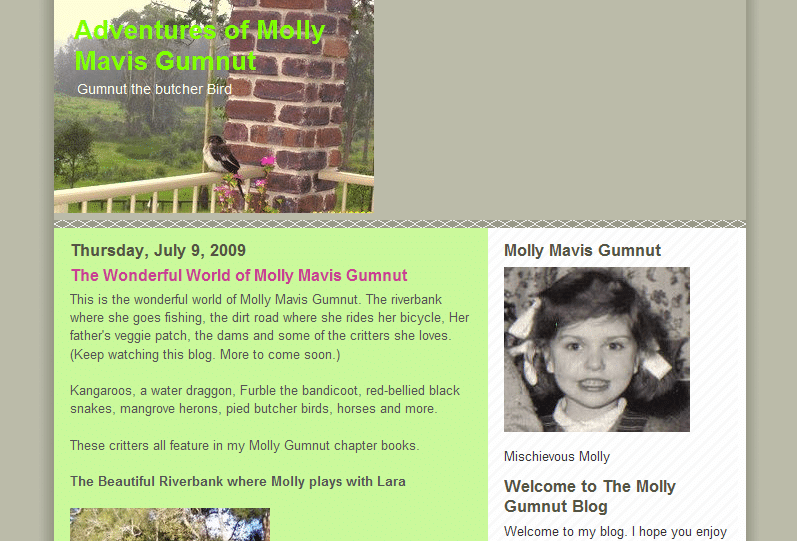
Today we’re looking at Trisha Puddle’s blog, Trish-MollyGumnut.blogspot.com. But Kathleen covered everything so well today that her comments will be the bulk of the post. (In case you’re wondering, we write our reviews separately, and if there’s overlap . . . actually, until now there’s never really been overlap!)
Jordan’s comments

Pages & content

The very last link on sidebar (last line) leads to your profile, where you have an email link. It would be easier for people to contact you with a dedicated contact page.

How can you get a contact page in Blogger? Make a post called “Contact” and put your contact information in it. Publish it, then use its URL in a menu bar. (Making a menu bar in Blogger can be a little technical, but you can find very, very simple instructions, too.)

So many writers hear the advice to start a blog and ask, “What would I blog about?” This is a great example of how you can blog about your research. You could also draw these posts out—limit posts to a few pictures at a time (probably five or fewer, so readers won’t be overwhelmed) and give a little more description. If you’re comfortable with it, maybe show a few lines from your WIPs about those animals and settings to put them into context—let us know what they mean even though we haven’t read the stories yet.

Some of the posts are a good example of an in-world character blog—but some of them aren’t. [Kathleen has more advice about both these last points, too.]

Search engine presence

On a search for your name, your Blogger profile is the #1 result on Google and #2 on Yahoo. Your blog shows up as #2 on Google. Once again, Bing is not being kind to our volunteers, and Yahoo doesn’t have your blog either.

However, on a search for [molly gumnut] (the name of her character and her series), the the one search engine that has your blog as #1 is Bing. That’s a first. #1 on Google is your Twitter profile. #1 on Yahoo is your Blogger profile again.

The other results are places around the web, mostly blogs and forums, where you’ve commented or posted work for critique. Search engines are listing a lot of other pages as more relevant than yours for your name and Molly’s name. You could definitely increase your search engine visibility. The same advice I’ve given others applies—guest blogging, linking back to your site using your name, etc. Since you have a few critique posts out there, you might consider emailing the blog owners to ask them to link your submission back to your blog.

Good luck!

Kathleen’s comments

Dear Trisha,

Your pictures of the wildlife around your house are great! Not many children (especially those in the city) can imagine seeing such variety.

I’d like to ask a question: Who visits your blog? Or rather, who do you WANT to visit your blog? Children? Their parents? Your friends? Publishing professionals?

Pretend you are that person, pretend you’ve never seen your blog before, and take a look at it with fresh eyes. What do you find?

First, it appears as though you, the author, are Molly Gumnut. (Lots of aspiring authors use childhood photos, for some odd reason.) You say, “Welcome to ‘my’ blog” . . . and since the only name we’ve been given is Molly’s, we assume that YOU are Molly. That, in turn, made me assume that these were stories from your childhood. I didn’t realize this assumption of mine was wrong until I scrolled down the bottom and happened to find your real name.

Second . . . you know the writing rule, “Don’t tell, show?” That applies to websites, too. People don’t want to be told what is somewhere on the site, they want to simply be presented with it.
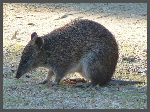
bandicootThat paragraph on the right is full of telling. “I will be adding pictures.” (When you add them, you SHOW us that.) “I will update them each week.” (That’s dangerous to put, because when they see you haven’t for a month and a half, they think the blog is abandoned. Don’t tell people how often you’ll update, just update! 🙂 ) “There are a number of links.” Just put the links in, rather than telling us that they’re there somewhere.

What do you want your blog to do instead? Well . . . just like a book, you want it to hook your readers immediately! In a book, you hook your reader with action. On a writer’s website, you hook your reader with the world of your books. That’s why your photos are so wonderful.

So all you need to do is clean this up so that the visitors realize they’re looking at pictures that reflect chapter books, rather than pictures from the author’s childhood.

Here are some ideas and suggestions:

1) Take out the childhood picture and see if you can find (or have someone you know draw) an illustration of Molly. That will help us realize that Molly is fictional. It doesn’t have to be amazing quality . . . even a child’s drawing would work, since these are children’s books. They will help portray “children” and “fiction.”

2) The picture at the top needs to fill the width of the blog. I also think that it should be an illustration that matches your illustration of Molly. Pick a fun scene out of one of your stories, and have someone draw a picture of Molly in that scene. The picture should include “The Wonderful World of Molly Mavis Gumnut” AND the words “by Trisha Puddle.” That also portrays “fiction” and gives us your name. If Molly lives in Australia, then make more of it! Americans are fascinated by Australia and the wildlife there, and I’m sure much of the rest of the world is, too! Then, make sure your background colors match those in the illustration.

3) Your welcome spot on the left . . . take out the “Welcome to The Molly Gumnut Blog” (you don’t really ever need to say “Welcome,” we know it’s a blog, and you’ll have her name up at the top), and take out the first seven sentences. They’re telling and won’t interest people. Instead, do a little bio of Molly, starting with the most interesting thing about her. ie: “Eight-year-old Molly learned to ride a turtle.” or “Molly decided to be a vet the day she watched snake eggs hatch.” Choose something really out-of-the-ordinary.

4) If you can, put an illustration-looking frame around each of your snapshots. This will pull the snapshots “into” the world of Molly. You can pretend that Molly (or her mother) took them, if you want. But this will keep the new site look of the fiction world cohesive. [Note that this is particularly effective if your see your potential audience as mostly children who will/have read your books.]

5) If you want to keep the links to animal rescue in the sidebar, go ahead . . . but you need to make them clickable links. Here’s how you do it.
Instead of just pasting the link in, surround it with this code:
<a href="http://www.TheLink.com">http://www.TheLink.com</a>

So your RSPCA link would be:
<a href="http://www.rspca.org.au/">http://www.rspca.org.au/</a>

It will LOOK the same on your blog, but it’ll be clickable instead of straight text. I’d also suggest putting it in Molly’s terms. “Molly loves to rescue animals, and you can help her by . . .”

6) Your most recent blog post: take out both “Wonderful Word of . . .” because you’ll have that in the header. A better post title might be “Where Does Molly Play?” Then just show the photos with the captions. Again, don’t TELL us the photos are there . . . especially when we’re about to be SHOWN them!

7) Finally, watch your grammar. I’m a grammar nerd, so not everyone will notice what I do . . . but you have quite a few fragments (that aren’t in someone’s POV to excuse them as thoughts), and some capitalized words in the middle of sentences that shouldn’t be, and a few missing commas around clauses. There aren’t a lot, but this blog is your face on the Internet. As an aspiring author, grammar problems will tell against you more than they do any other group of people.

I hope this is helpful to you, and good luck with your books! The post you did where you mentioned Molly trying to rescue a bandicoot caught my interest, since I’m not even sure what a bandicoot is!

-Katie/Kathleen
http://www.KatieDidDesign.com
http://www.KathleenMacIver.com

What do you think? Could you do a whole blog (not just a post) in your character’s world? How can you use the world of your books to hook your website visitors?

Photo credit: bandicoot by Greenstone Girl